What is The Difference Between Electric and Induction Cooktops?
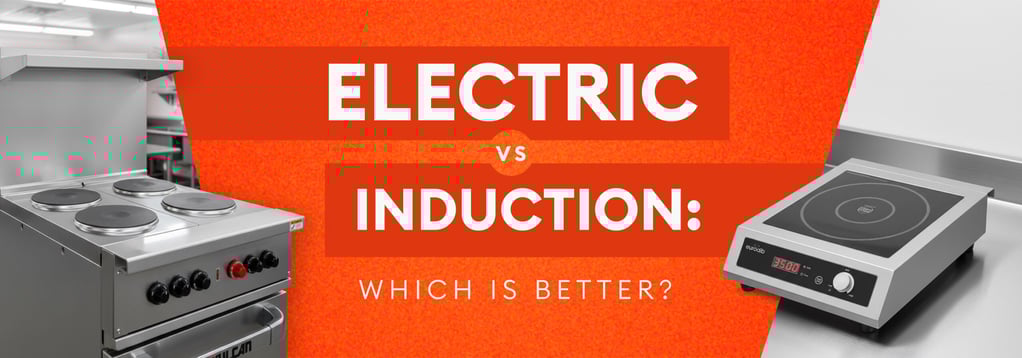
Electric and induction are two of the most common alternatives to gas-powered burners in commercial kitchens. Electric burners heat elements in a metal hot plate, while induction burners use electromagnetic technology that directly heats the pan in contact with the burner's surface. This article compares the main differences between induction and electric stoves to help operators find the best option for their kitchen.
Key Takeaways
- Induction burners heat up faster and are typically more energy efficient than electric burners
- Induction cooktops are more expensive than electric heating, cannot heat certain types of pans, and typically have less capacity than electric models
- Choose an option that fits your service style. Induction boasts precise heating and simple cleanup, while electric is more versatile and more economic up front
How Do Induction Cooktops Work?
Induction technology is a relatively new cooking method based on principles of electromagnetism first commercially produced in the late 20th century. It works by using an electromagnetic current to directly heat cookware placed on a glass-covered coil. Rather than heating the surface the pan sits on, induction heats the pan itself, making for a nearly 100-percent heat transfer from the heating source to the pan. The pan must be ferrous—meaning it contains iron and is therefore magnetic—to be considered induction compatible. "Induction is incredibly efficient, but it comes with its challenges," Southbend Vice President of Sales and Marketing Bryant Woolcock told KaTom. "It's more expensive, and it takes a different skillset. A lot of chefs are used to seeing a flame, but you can't see the power of induction. So, it's not as visual."
Pros of Induction Cooktops
- Energy Efficient: Induction heats the pan bottom, not the environmental surface
- Quick Cook Times: Direct heating leads to faster energy transfer
- Simple to Clean: Food won't bake onto the glass surface
Cons of Induction Cooktops
- Up-Front Cost: Single burner units cost several hundred dollars, while multi-burner cooktops cost several thousand
- Cookware Compatibility: Only works with pots and pans containing iron
- Capacity: Many induction cooktops only have one or two burners per model

Although induction cooking is powered by electricity, it's different than standard electric cooking because it uses electromagnetism to heat cookware rather than conduction.
What is an Electric Cooktop?
Electric cooktops use heated coils or radiant elements beneath smooth metal plates to transfer heat to cookware. Some electric ranges also heat griddles with embedded electric elements.
Pros of Electric Cooktops
- Versatile: Can be used with most cookware styles
- Easy Installation: Standard range sizes with no gas connection
- Retains Residual Heat: Keeps pots and pans hot after turning power off
Cons of Electric Cooktops
- Uneven Heating: Less consistent than induction
- Slower Cook Time: Longer to heat up than gas or induction
- Energy Waste: More efficient than gas, but less efficient than induction

Shop KaTom's Induction or Electric Cooktops

Eurodib C1823 Single Burner

Waring WIH800 Double Burner

Vollrath 924HIDC Four Burner

Vulcan EV12-2FP208 Double Burner

Imperial IR-6-E Six Burner

Garland SS684 Ten Burner
Key Differences Between Electric and Induction Cooktops
| Feature | Induction Cooktop | Electric Cooktop |
|---|---|---|
| Heating Method | Electromagnetic energy directly heats cookware | Electric coils/radiant elements heat the surface, then the cookware |
| Heating Speed | Very fast | Slow |
| Energy Efficiency | High (minimal heat loss) | Moderate |
| Temperature Changes | Precise and responsive | Slower to adjust |
| Cookware Compatibility | Requires ferrous layer on bottom of cookware | Works with any flat-bottom cookware |
| Safety | Surface stays cool; auto shut-off when cookware removed | Surface stays hot; slower cooldown |
| Cost | Higher upfront | Lower initial cost |
| Ease of Cleaning | Cooler surface prevents burnt-on spills | Residual heat can bake on spills |
1. Heating Speed
- Induction cooktops generate heat directly within cookware, rather than below the cooktop surface, so dishes reach high temperatures quickly
- Electric cooktops transfer heat from heated coils through a cast iron surface and then onto cookware, so processes like boiling can take longer
2. Temperature Changes
- Induction cooktops offer precise digital temperature controls that heat pans to the desired temperature within a few degrees. They also enjoy a wide temperature range
- Electric cooktops Typically use dials for relative temperature control and have slow response times
3. Cookware Compatibility
- Induction cooktops require ferrous cookware for magnetic heat conductivity. This includes cast iron, most carbon steel, and most stainless steel cookware
- Electric cooktops Works with most cookware, including non-ferrous materials like aluminum and copper
4. Safety Considerations
- Induction cooktops remain cool to the touch when turned on. They're also safer to use because they automatically shut off when pans are removed from the burner or when liquid boils over.
- Electric cooktops Heat cooking surface to high temperatures and retain heat after turning the burner off
5. Energy Efficiency
- Induction cooktops provide one of the most efficient cooking methods with fast heat times. However, they lose much of this efficiency if oversized cookware is used. "Gas burners are around 35 to 45 percent efficient, electric about 65 to 75 percent, and induction reaches roughly 95 percent—by far the most efficient option," Woolcock said.
- Electric cooktops are slower to heat than induction cooktops and lose heat to the surrounding environment. Nonetheless, at peak performance, electric cooktops come close to the same efficiency as induction for longer cooking tasks1
6. Ease of Cleaning
- Induction cooktops use glass surfaces that don't heat up and won't cake on spilled food
- Electric cooktops with radiant heat use easy-to-clean glass or metal, but these hot surfaces can bake spills on
7. Cost
- Induction cooktops come in economical models, but premium options have some of the highest up-front costs per burner
- Electric cooktops offer a lower cost per burner, but multi-burner ranges are comparable in price to multi-burner induction cooktops
Which is Better: Electric or Induction Cooktops?
The best cooktop option depends on your kitchen priorities. Ponder factors like speed, precision, budget, and the type of cookware you use. Explore all induction and electric options at KaTom. "Electric ranges bump up efficiency compared to gas," Woolcock said. "But induction takes it to a much further, nearly perfect, efficiency with much faster heat response."
References
- Is Induction More Efficient Than Electric Coil or Gas? An Energy Efficiency Comparison Between Stoves CenturyLife.org. Accessed October 2025.

