Equipment & Supply Ideas for Compact Commercial Kitchens
Whether you're retrofitting an existing space or have the luxury of designing a commercial kitchen from scratch, creating a kitchen that helps your foodservice operation keep up with daily demands can be especially challenging if you have a small footprint. A layout that works against your cooks instead of helping them maximize efficiency can slow down production, negatively impacting customer satisfaction, turnover time, and your bottom line. Many commercial foodservice operations have to work with a space that wasn't built specifically for their needs – so, how do you get a big back-of-house benefits out of your small kitchen?
6 Ways to Maximize Space in Small Commercial Kitchens
Most restaurant equipment is sized for large operations, but many manufacturers provide smaller models that offer great performance while requiring less space than their more robust counterparts. Considering incorporating these pieces to get the abilities of a big facility in your limited space.
- Rely on an undercounter ice maker.
In many cases, an undercounter ice maker can provide the same level of daily production as a head-and-bin combination unit. They're also available in models that are perfect for low-volume places, providing from a couple dozen pounds of ice per day to nearly 100 – all in just a few square feet of what might otherwise be unused space. If you're concerned an undercounter ice machine won't be able to meet the needs of your established, consider lessening the demand for ice by limiting how often it's provided with beverages. For example, some restaurants only provide ice with water when it's specifically requested or opt to have servers leave chilled carafes at the table.
- A commercial refrigerator-freezer combination does double the work.
A dual-temperature refrigerator isn't for every foodservice operation, even if it has a cramped kitchen, but they can be great for low-volume operations or those that need two types of cold storage in a small footprint. As the name suggests, these combine the abilities of both a commercial refrigerator and a commercial freezer in a single unit. They come in models with a single section, where the refrigerated and freezer portions are stacked, as well as two- and three-section models featuring the refrigerator and freezer side-by-side. A double-section dual-temperature refrigerator takes up less room than a single-section commercial refrigerator and a single-section commercial freezer, making it great for most any compact commercial kitchen.
- Enjoy more flexibility in your menu with a combi oven.
Depending on what you're serving, the combi oven may be a great addition to your restaurant equipment roster. These units offer the even heating of a convection oven with the cooking power of a steamer in a single machine, so they can be used to bake, roast, steam, and retherm foods. They're available in single-deck models, and in double-deck models that stack. You can also purchase a combi oven in a countertop model that provides all that cooking power without taking up precious floor space in your kitchen.
- Get your restaurant equipment off the floor.
Countertop cooking equipment can be one of the easiest ways to maximize space in a compact commercial kitchen. Units that fit on your countertop move crucial pieces off the floor, freeing that floor space for full-sized refrigeration and other pieces that can't be compact.
- Use chef bases to create all-in-one cooking and prep stations.
Whether your commercial kitchen's biggest export is fried shareables, crispy chicken, steaks, or burgers, a chef base provides cold storage and cooking solutions in one footprint. These pair well with countertop fryers, charbroilers, panini presses, and other pieces of equipment popularly used to prepare in-demand appetizers and entrees. They can also be used with commercial slicers in delis, pizzerias, and sandwich shops that prepare meat in-house.
- Get ingredients out of the way with ingredient bins.
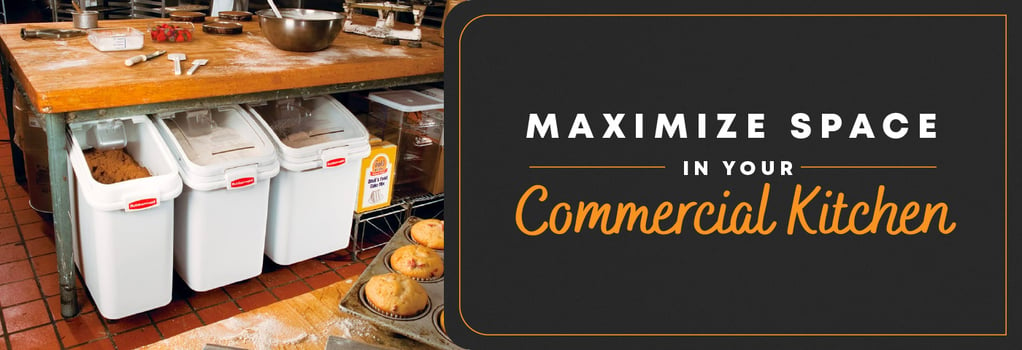
Stay ahead of workflow pains that will frustrate your cooks by keeping bulk ingredients off countertops and storing them securely in ingredient bins. These containers are great for flour and other dry ingredients that commercial kitchens use in bulk; they can be stored under your counter to offer quick access to your commercial kitchen's most-used ingredients, and many models are large enough to be mounted in wheels for easy mobility. This makes them one of the best ways to maximize space and to improve efficiency.
