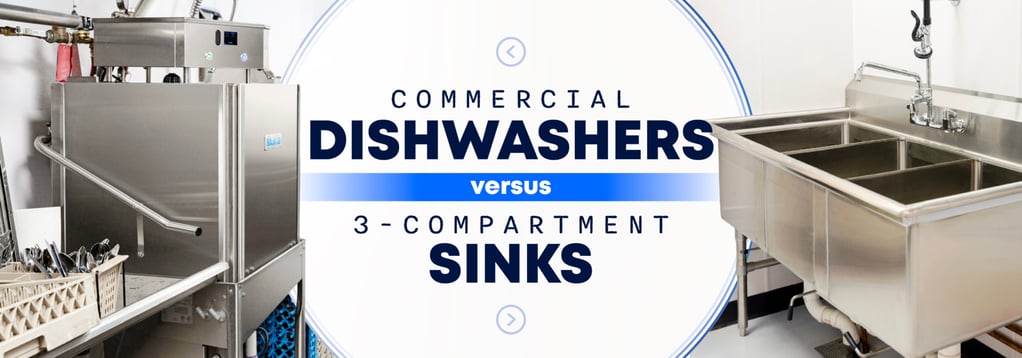
Commercial Dishwashers vs 3-Compartment Sinks
Commercial dishwashers and 3-compartment sinks both clean and sanitize tableware, but they differ in throughput, labor, water usage, and sanitation reliability. Commercial dishwashers process large amounts of tableware in a short amount of time while dispensing measured amounts of detergent and sanitizer. Three-compartment sinks handle smaller quantities of tableware for lower-volume operations or kitchens with limited space. Three-compartment sinks may be required in foodservice operations under health codes based on FDA guidelines. The best choice for your kitchen depends on volume and usage.
Features of a Commercial Dishwasher
There are three main types of commercial dishwashers: undercounter, door-type, and conveyor. Undercounter dishwashers are compact, front-loading units designed to fit beneath counters. Door-type dishwashers are larger pass-thru machines that let staff load racks from one side and unload them from the other. Conveyor dishwashers are designed for continuous operation, moving racks through the machine on a conveyor, providing the highest throughput of the three types.
Tableware is sorted into specialized racks, then rolled or loaded into the dishmachine. High-temperature commercial dishwashers use water heated to at least 180 degrees Fahrenheit to sanitize items in about 90 to 120 seconds. Internal pumps send hot water and detergent through rotating arms to strip away debris and grease. The high water temperature leaves enough residual heat for the thin layer of rinse water to evaporate quickly, enabling items to air dry.
"A commercial dishwasher can improve speed, sanitation, and consistency for operations that struggle with labor, washroom performance, or high dish volume." — Taylor Heilbronner, Business Development Manager of Hobart Warewash and Waste

MoTak MUC-HT30 High Temp Rack Undercounter Dishwasher - (30) Racks/hr, 208-240v/1ph

Centerline by Hobart CDL-1 Low Temp Door Type Dishwasher w/ 51 Racks/hr Capacity, 120v

Jackson AJ-86CE 102" High Temp Conveyor Dishwasher w/ 287 Racks/hr Capacity, 208v/3ph
Features of a 3-Compartment Sink
Most health regulations require foodservice establishments to have a 3-compartment sink to provide a manual warewashing option if a commercial dishwasher is unavailable or stops working. The FDA Food Code 1 outlines the recommended steps for properly washing tableware in a three-compartment sink.
Many commercial foodservice operations use 3-compartment sinks for manual warewashing or as a backup to a dishwasher. Each compartment serves a purpose: the first sink is used for washing with hot, soapy water; the second is filled with clean, warm water for rinsing; and the third is used for sanitizing with hot water or a chemical sanitizer. Separating the wash, rinse, and sanitize steps helps prevent cross contamination and keeps bacteria off tableware.

Krowne 18-53C 60" Silver Series 3 Compartment Sink w/ 10"L x 14"W Bowls, 7" Deep

Splash 57" 3 Compartment Sink w/ 18"L x 21"W Bowls, 12" Deep (21-1281-3-SB8KB)

Advance Tabco SLB-33C 36" 3 Compartment Sink w/ 10"L x 14"W Bowl, 10" Deep
Comparing Dishwasher & Sink Performance
Throughput
Commercial dishwashers process tableware much faster than manual washing in a 3-compartment sink. This makes them a practical choice for high-volume operations needing to keep up with a steady flow of dirty dishes.
Labor
Commercial dishwashers require less hands-on labor than three-compartment sinks because they automate much of the washing process. One operator can load, start, and unload racks, then check gauges or indicator lights to verify water temperature and detergent dispensing. Staff using a 3-compartment sink must stay at the station to wash, rinse, and sanitize each item by hand.
Who is Taylor Heilbronner?
Taylor Heilbronner is a Business Development Manager for Hobart Warewash and Waste, where he works with market partners, dealers, and end users to build relationships and deliver equipment solutions. With more than 20 years of experience in foodservice and hospitality, Heilbronner has held roles in restaurant operations, equipment sales, project management, distribution, and business development. His background includes training teams for new restaurant openings and helping operators plan and source equipment, giving him a practical understanding of the challenges foodservice businesses face every day.
Water Usage and Consistency
ENERGY STAR-certified commercial dishwashers use less water than standard models and can save operations more than 5,000 gallons of water annually 2, depending on the product type. Built-in heaters keep the water at the optimal temperature, while each rack receives the same wash time and pressure. "Hot water sanitizing can provide strong washing efficiency, but operators need to confirm they have enough electrical capacity for the booster heater," Heilbronner said.
Some 3-compartment sinks hold 6 gallons of water per sink, and each compartment must be refilled when the water gets dirty or cold. Staff must check the temperature and add hot water as needed. Scrubbing time, detergent use, and rinsing also depend on the employees handling the task.
Sanitation and Chemical Concentration
Automated chemical dispensing provides consistent, precise sanitation, and reduces human error compared to manual washing in a three-compartment sink. Commercial dishwashers automatically deliver measured amounts of detergent, rinse aid, and sanitizer each cycle. Many machines also include gauges, indicator lights, or alarms to alert operators when supplies are low or another issue affects performance. "In most commercial kitchens, a dishwasher is more efficient and consistent than hand washing because it improves throughput and provides more reliable sanitization," Heilbronner said.
Three-compartment sinks require staff to manually add and monitor detergents and sanitizers, so chemical concentration and water temperature depend on accurate measurements and regular testing. Operators must also maintain the proper water temperature and sanitizer concentration throughout the warewashing process.
Choosing Between a Commercial Dishwasher & 3-Compartment Sink
High-Volume Operations
Commercial dishwashers can handle large amounts of tableware while reducing the time between wash cycles.
Low-Volume Operations
Three-compartment sinks offer a practical solution when smaller quantities of tableware can be washed manually.
Labor and Space
Operations with limited labor may benefit from a commercial dishwasher's automated washing process, while those with limited space or budget may prefer a 3-compartment sink.
Using Both
Many operations may benefit from having both options available for different warewashing tasks, including prewashing, cleaning pots and pans, handling oversized items, and providing backup capacity.
Which One Is Right for Your Operation?
| Factor | Commercial Dishwasher | 3-Compartment Sink |
|---|---|---|
| Throughput | High-volume, automated cycles | Low-volume, manual washing |
| Labor | Less hands-on | More staff involvement |
| Water Consistency | Controlled wash and rinse cycles | Depends on staff oversight |
| Chemical Concentration | Often automatically dispensed | Must be manually measured and maintained |
| Sanitation | Consistent cycles when properly operated | Relies more heavily on correct procedures |
| Space | Requires dedicated space | Required in many operations regardless of size |
| Best For | High-volume operations | Lower-volume or specialty washing |
