Which Knife is Best for You?
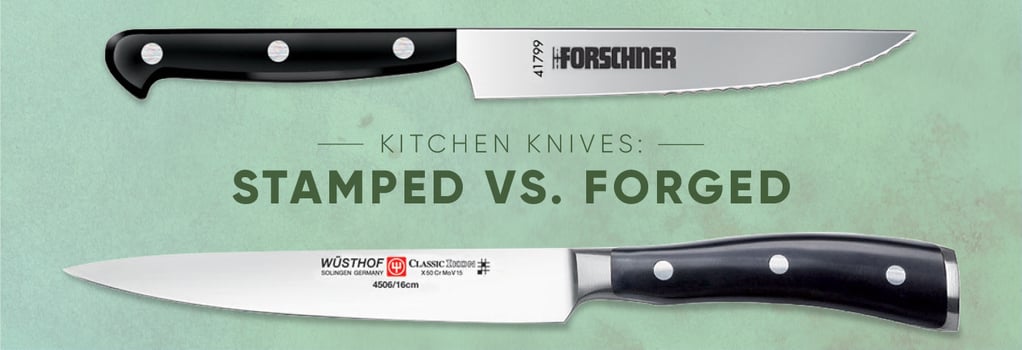
As some of the most-used tools in any kitchen, having reliable, comfortable kitchen knives for every task is essential. There has long been a debate among chefs and craftsmen alike on whether forged or stamped knives are the superior option. Forged kitchen knives were considered tops by many for a long time, but recent advances in technology have renewed the debate. Below, we look at some of the benefits and drawbacks of both manufacturing processes.
How Knives are Made
The traditional method of forging a knife required a skilled craftsman to heat a bar of metal and hammer it into the proper shape before sharpening, but modern technology has changed that process significantly. For example, instead of starting as a thick piece of steel and everything but the bolster being hammered down, a Wusthof forged knife starts as a thin steel blank. The center part of the blank is heated, then both ends are pushed in to form a solid bulge of metal that is shaped into a bolster. The knife is then heat-treated for strength and corrosion resistance.
Despite the name, stamped knives are rarely forcibly punched out. Instead, most manufacturers use lasers to cut knife blanks out of rolls of sheet metal. These blanks are then shaped and sharpened, and some manufacturers also put them through heat treatment processes. However, a stamped kitchen knife will rarely go through as intense a heat treatment regimen as a forged knife, which means the final product is a bit less durable.
Pros & Cons
Forged Knives

Forged knives are thicker and heavier than their stamped counterparts. Due to the manufacturing process, they also have bolsters that add weight to the knives, which some users feel provides a more well-balanced blade. The bolster can also provide a measure of protection to the user's fingers, since it provides a natural stop to how far up on the handle the hand goes. Because forged knives generally have full tangs, meaning the metal from the blades runs all the way through the handles as well, rivets are common and the metal is often visible on the tops and bottoms of the handles.
Pros:
- Forged knives have bolsters, which offer additional stability and can provide protection to users' fingers.
- The forging process strengthens the steel of the knife, which may mean it does not need to be honed or sharpened as often.
- The stronger blades of forged knives can be easier to sharpen because they do not warp against whetstones.
- The bolsters and full tangs that are common on forged knives help balance the blades, making them easier to maneuver.
Cons:
- The bolster and full tang add weight to the handle that can contribute to user fatigue over time.
- The blade is less flexible, which can make tasks like boning poultry and fileting fish more difficult.
- Due to the amount of time and labor required to create forged kitchen knives, they are more expensive than comparable stamped knives.
Stamped Knives

Stamped kitchen knives are thinner overall than their forged counterparts, making them more flexible. Because they are cut from sheets of metal, these knives do not have bolsters. Stamped knives may have a full tang or a partial tang. You can identify the tang length by looking at the top and bottom of the knife handle. If metal shows on the top but not the bottom, it may be a partial tang. Partial tangs are considered by many to be less durable, as the knife handle is often glued on instead of riveted.
Pros:
- Stamped kitchen knives are lighter than similarly sized forged knives and can be used for longer stretches of time with a lower risk of fatigue.
- The lack of a bolster is more comfortable for some kinds of knife grips and certain uses.
- A stamped kitchen knife is usually more flexible than a forged knife, making it ideal for tasks like boning that require a little give in the steel.
- Stamped knives are the more economical option.
Cons:
- Because they are not heat treated to the same extent as forged knives, stamped knives may break or corrode more easily.
- The flexibility of a stamped knife makes it harder to sharpen reliably, as it may warp and flex against a honing steel or sharpening stone.
- Few stamped knives have full tangs, which combined with the lack of a bolster can mean some knives are not balanced, with the blade being much heavier than the handle.
- Not having a bolster eliminates that natural stop to the hand that can protect fingers from getting under the blade.
Who Does What?
Many knife manufacturers produce both forged and stamped knives, offering a selection of knives in a wide range of price points, and with various handle and design options. Below are some of the major commercial knife manufacturers and the lines of forged and stamped kitchen knives they manufacture.
| Wusthof | Dexter-Russell | Victorinox | |
|---|---|---|---|
| Forged |
|
|
|
| Stamped |
|
|
|
- Inside the Factory. Popular Science. Accessed March 2018.
