Types of Ice: Ice Shapes & Ice Cube Names
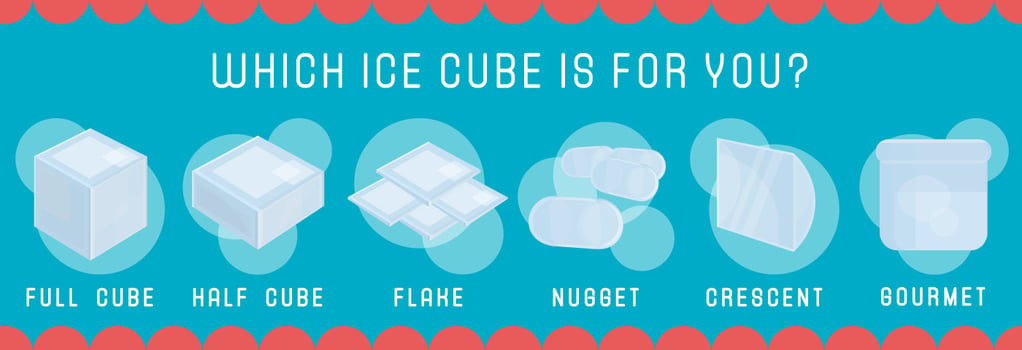
The type of commercial ice maker you choose should be guided by what you plan to use it for and, in some cases, what type of establishment you’re buying it for. In a national survey, 56 percent of respondents said crushed ice is the best ice, followed by cubed ice at 30 percent and nugget ice at 19 percent, showing that different ice formats appeal to different use cases rather than a single universal favorite. Our guide makes it simple to sort through all the choices armed only with those two facts.
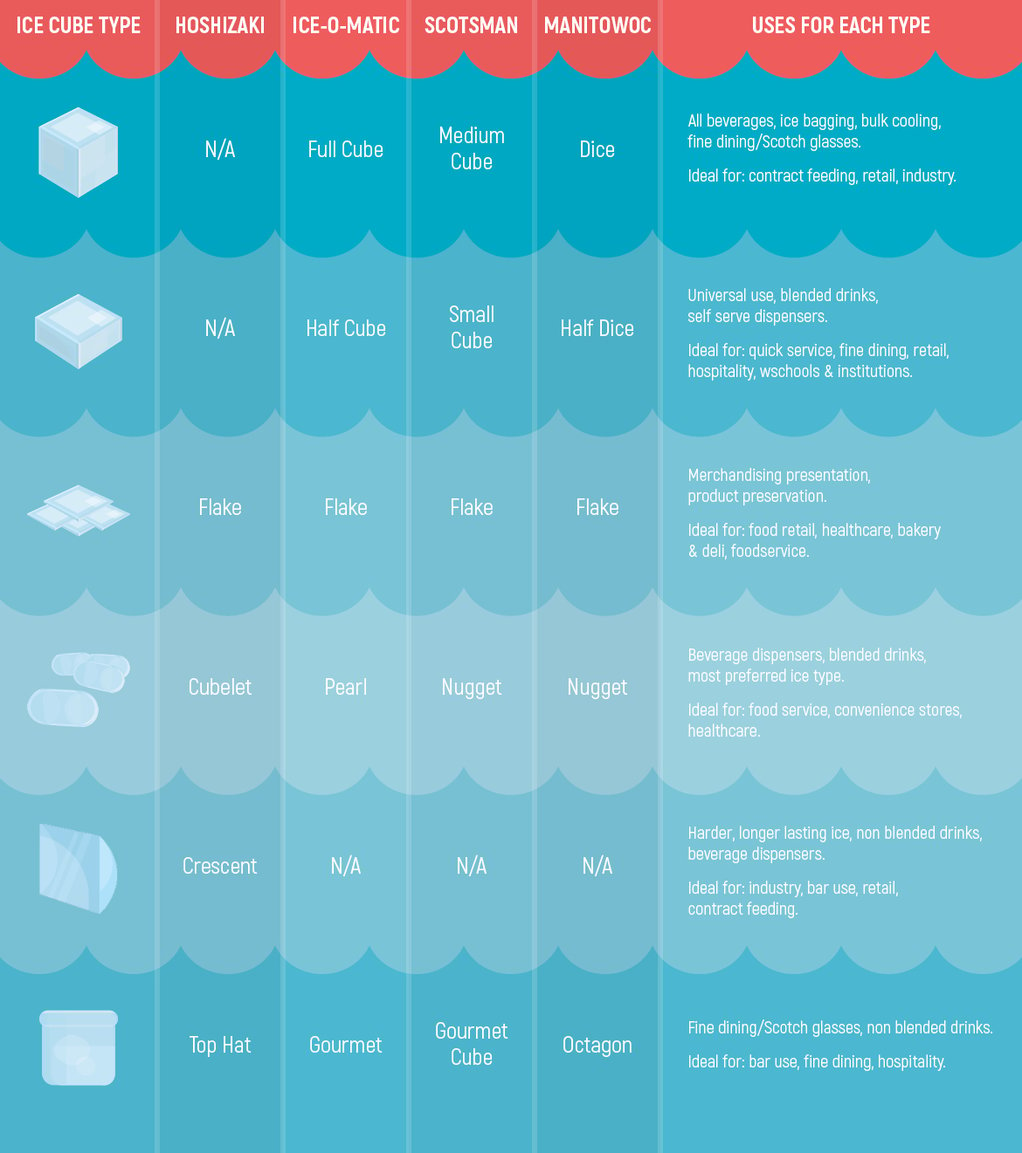
When selecting an ice machine, the most important thing to keep in mind aside from production rate is the shape of the ice that the machine makes. Each different type of ice has its own benefits and drawbacks. The following infographic will introduce you to the commercial ice makers KaTom sells based on the types of ice each produces. To learn more about different types of ice, check out the buying guide just below the graphic.
Table of Contents
Full-Cube Ice
Full ice cubes are uniform and provide a clean look. Due to the larger size and slower melting rate, full ice cubes offer maximum cooling while saving money by reducing ice consumption. Thirty percent of respondents prefer cubed ice in fast-food drinks, with preference increasing among older demographics who value slower melt rates and drink longevity.
Best Ice For:
- Soft drinks
- Mixed drinks
- Bagged ice
- Ice for dispensing
Best Type of Ice Maker For:
- Bars
- Baggers
- Many restaurants,/li>
Melt Rate: Slow
Ice Size: 7⁄8 in. x 7⁄8 in. x 7⁄8 in.
Common Full-Cube Ice Names:
- Full cube
- Regular cube
- Dice cube
- Square cube
Popular Full-Cube Ice Makers:
- Hoshizaki Full-Cube Ice Makers
- Ice-O-Matic Full-Cube Ice Makers
- Manitowoc Full-Cube Ice Makers
- Scotsman Full-Cube Ice Makers
The scoop on the commercial full-cube ice maker:
These produce the larger rhomboid ice cubes typical in bars and in soft drinks in some restaurants. The solid build of this ice type makes it perfect for soda or spirits. Full-cube ice has a high ice-to-water ratio, which offers maximum cooling and a slower melt, pleasing customers and cutting down on production needs. They’re also great for large-volume applications, including bagging and bulk cooling.
Half-Cube Ice
Half-cube ice is a versatile option that fits seamlessly into soft drinks, mixed beverages, and dispensing machines. Its smaller size allows for quick chilling without diluting drinks too fast, making it ideal for restaurants and convenience stores.
Best Ice For:
- Soft drinks
- Mixed drinks
- Frozen cocktails
- Bagging
- Ice for dispensing
Best Type of Ice Machine For:
- Restaurants
- Convenience stores
- Dispensers
- Most any commercial kitchen
Melt Rate: Moderate
Ice Size: 7⁄8 in. x 7⁄8 in. x 3⁄8 in.
Common Half-Cube Ice Names:
- Half cube
- Half dice
- Crescent cube (see below)
- Small cube
Popular Half-Cube Ice Makers:
- Hoshizaki Crescent-Cube Ice Makers
- Ice-O-Matic Half-Cube Ice Makers
- Manitowoc Half-Cube Ice Makers
- Scotsman Half-Cube Ice Makers
The scoop on the commercial half-cube ice machine:
Half cubes are typically smaller versions of cube or dice ice, though the Hoshizaki equivalents are crescent cubes, which we cover later in this guide. Half-cube ice is considered the most versatile type of ice, which is why it shows up in restaurants, convenience stores, dispensers, and baggers. That diversity has made this commercial ice maker the most popular, despite the fact you’re not likely to find it in most bars. Like full cubes, half-cube ice offers a relatively high ice-to-water ratio, which means a solid piece of ice that won't water down drinks as quickly, has more cooling power, and lowers production needs.
Nugget Ice
Nugget ice’s small, airy pieces absorb drink flavors and cool quickly, and are great for use in ice dispensers so they're convenient addition to high-volume operations and healthcare settings. That popularity shows up in consumer data: 19 percent of respondents rank nugget ice as the best ice for fast-food drinks, with preference rising among younger consumers as 27 percent of Gen Z and 24 percent of Millennials preferring nugget ice."Jeff Biel, Vice President of Marketing and Product Development at Scotsman, notes how quickly nugget ice became a consumer favorite in the market place.. “Scotsman invented that ice form a number of decades ago, and we’ve continued innovating to meet demand.” Today, it’s the ice of choice for fast food chains and coffee shops, many of which even sell it by the bag due to its widespread popularity.
Best Ice For:
- Fountain beverages
- Specialty soft drinks
- Blended cocktails
Best Type of Ice Maker For:
- Restaurants
- Bars
- Convenience stores
- Properly-equipped dispensers
- Any eatery where drinks are the profit drivers
Melt Rate: Fast
Ice Size: 3⁄8 in. to 1⁄2 in. width and length
Common Nugget Ice Names:
- Pearl ice
- Nugget ice
- Tubular nuggets
- Cubelet
- Chewblet ice
- Pebble ice
- Pellet ice
- Sonic ice
Popular Nugget Ice Makers:
- Follett Nugget Ice Makers
- Hoshizaki Nugget Ice Makers
- Ice-O-Matic Nugget Ice Makers
- Manitowoc Ice Nugget Ice Makers
- Scotsman Nugget Ice Makers
Nugget Ice Terminology:
- Manitowoc: Nugget, tubular nugget
- Hoshizaki: Cubelet
- Scotsman: Nugget
- Follett: Chewblet® Ice
- Other: pebble ice, pellet ice, Sonic ice
The scoop on the commercial nugget ice maker:
These little chunks of ice have several names, but one thing that has made them famous: The attraction they hold for those who love to chew ice. Nugget has become their go-to, and the establishments that cater to them have taken note. So popular are nuggets that The Wall Street Journal has even recognized the growing allure of nugget ice commercial ice makers, and Sonic has centered a business model on drinks built around nugget ice.
Beyond being chewable, nugget ice is drier than flake ice, so it’s better in dispensers, readily absorbs the flavor of the drink, and blends well in frozen drinks and smoothies. Since customers expect more ice when they’re getting this chewable type and since you can pack these small pieces in more tightly, you’ll save money on drinks. However, if you’re using nugget ice and offering refills on it, count on spending more money on ice. That’s not just because people will crunch the ice, but also because it melts more quickly than solid types thanks to all those nooks and crannies, which increase the surface area of the ice.
Crescent Ice
Best Ice For:
- Soft drinks
- Mixed drinks
- Bagging
- Dispensing
Best Type of Ice Maker For:
- Restaurants
- Convenience stores
- Dispensers
- Most commercial kitchens
Melt Rate: Moderate
Ice Size: 11⁄2 in. x 11⁄8 in. x 1⁄2 in.
Common Crescent Ice Names: Hoshizaki is the only manufacturer that makes a commercial ice maker that produces crescent cubes. Though it’s unique to one company, crescent ice has a fan base among both restaurateurs and customers, some of whom will seek it out.
The scoop on the commercial crescent ice machine:
Its uses are the same as half cubes because the crescent cube is essentially Hoshizaki’s entry in that category. What differentiates it from the class is that curved side, which allows it to fill a glass better, which means more ice and less drink, cutting costs. Though the shapes are different, the commercial ice machines that produce crescent cubes use the same process as other cubers.
Flake Ice
Flake ice is soft and moldable, making it ideal for food displays and healthcare use. Flake ice provides efficient cooling with minimal waste. While only 6 percent of consumers prefer flake ice in drinks, its real value lies outside beverages and particularly in healthcare, seafood displays, and injury treatment, where comfort and rapid cooling matter more than melt rate. Its fast cooling properties make it perfect for keeping perishables fresh and creating visually appealing presentations.
Best Ice For:
- Produce
- Chilled foods on a buffet
- Seafood or meat in a display
- Blended cocktails
- Medical uses
Best Type of Ice Machine For:
- Buffets
- Grocery stores
- Fish markets
- Anywhere putting chilled food on display
- Healthcare and institutions
Melt Rate: Fast
Ice Size: Varies
Common Flake Ice Names: Everyone actually agrees on this one: It's flake ice.
Popular Flake Ice Makers:
- Hoshizaki Flake Ice Makers
- Ice-O-Matic Flake Ice Makers
- Manitowoc Ice Flake Ice Makers
- Scotsman Flake Ice Makers
The scoop on the commercial flake ice machine:
Flake ice also has some stock with ice chewers, though it’s less likely to show up in drinks unless they’re mixed or frozen. Its main chewed usage comes in healthcare institutions, where its small size makes it perfect for serving drinks without the possibility of patients choking on ice chunks. It is also the ice of choice for packing around injuries, since it forms easily and doesn't have corners to poke into flesh.
Flake ice is ideal for food presentation settings like buffets and produce markets, and works beautifully in drinks that are primarily spirits, with no water to cut them. Its 73 percent ice-to-water ratio makes it light and chewable. Unfortunately, it also melts more rapidly, so it will disappear more quickly in drinks.
Gourmet Ice
Gourmet ice covers several different designs, all of which have one thing in common: their purpose is to add an aesthetic value to high-end drinks.
Best Ice For:
- High-end liquors
- Drinks at premium eateries or events
Best Type of Ice Maker For:
- Upscale restaurants
- Event and banquet halls
- Bars
Melt Rate: Slow
Ice Size: 13⁄8 in. x 13⁄8 in. or 11⁄4 in. x 11⁄8 in. x 7⁄8 in. depending on shape
Common Gourmet Ice Names:
- Gourmet
- Top hat ice
Popular Gourmet Ice Makers:
- Hoshizaki Gourmet Ice Makers
- Ice-O-Matic Gourmet Ice Makers
- Kold Draft Gourmet Ice Makers
- Scotsman Gourmet Ice Makers
The scoop on the commercial ice maker:
For Manitowoc, gourmet ice comes in a unique octagonal shape, while Ice-O-Matic, Hoshizaki, and Scostman have cylindrical ice that looks like a top hat. In each case, the individual piece is larger than other types of ice and has nearly a perfect ice-to-water ratio, meaning a beautiful, crystal-clear cube that is extremely effective at cooling beverages. Drop one or two into a hi-ball with some well-aged Scotch and you’ve got a premium presentation that high-dollar customers love. Because the pieces are so large and solid, you need fewer of them to do the job, and since they’re too substantial for chewers, you won’t be making repeat trips to the table to replace ice that was munched.
Also included in this category are specialty ice styles that are even larger than the standard gourmet ice. Ice-O-Matic offers the grande cube, a large, solid piece of ice that is 11⁄4 inches wide by 11⁄8 inches deep by 7⁄8 inches high.
Types of Ice: FAQs Answered
What type of ice does Sonic use?
Sonic uses nugget ice, also known as "chewable ice" or "pellet ice." This type of ice is soft, small, and easy to chew, making it a fan favorite for its texture and ability to absorb drinks' flavors.
What type of ice does chick-fil-a use?
Similar to Sonic, Chick-fil-A uses nugget ice, known for its chewable texture and popularity in various ice cube shapes.
What is the best type of ice from commercial ice makers?
The best type of ice depends on the application: nugget ice is great for chewability, while gourmet ice offers slow melting and a premium look. The right commercial ice maker choice depends on your needs.
What type of ice lasts the longest?
Gourmet ice and full-cube ice last the longest due to their larger ice cube size and solid structure, which melt more slowly than other ice shapes.
What is the most preferred ice for fast-food drinks?
Crushed ice ranks highest at 56%, followed by cubed ice (30%) and nugget ice (19%), highlighting how ice choice varies by drink type and customer expectation.

