How an Ice Machine Refrigeration System Works
Refrigerators, ice makers, and air conditioners all use the same basic cooling principle: a refrigeration cycle that removes heat from the environment. Early mechanical ice makers were invented in the mid-19th century for medical purposes. Today, Commercial ice makers come in numerous configurations, ice shapes, and production volumes and are used in nearly every operation for cooling drinks, chilling ingredients, and more.
Key Takeaways
- Commercial ice machines use a refrigeration system to remove heat from water
- Refrigerant circulates through the compressor, condenser, expansion valve, and evaporator
- Water freezes on the evaporator surface until the ice reaches the desired thickness
- The harvest cycle releases finished ice into a storage bin
- Different machine designs produce cube, nugget, flake, and gourmet ice
Refrigeration Cycle Diagram
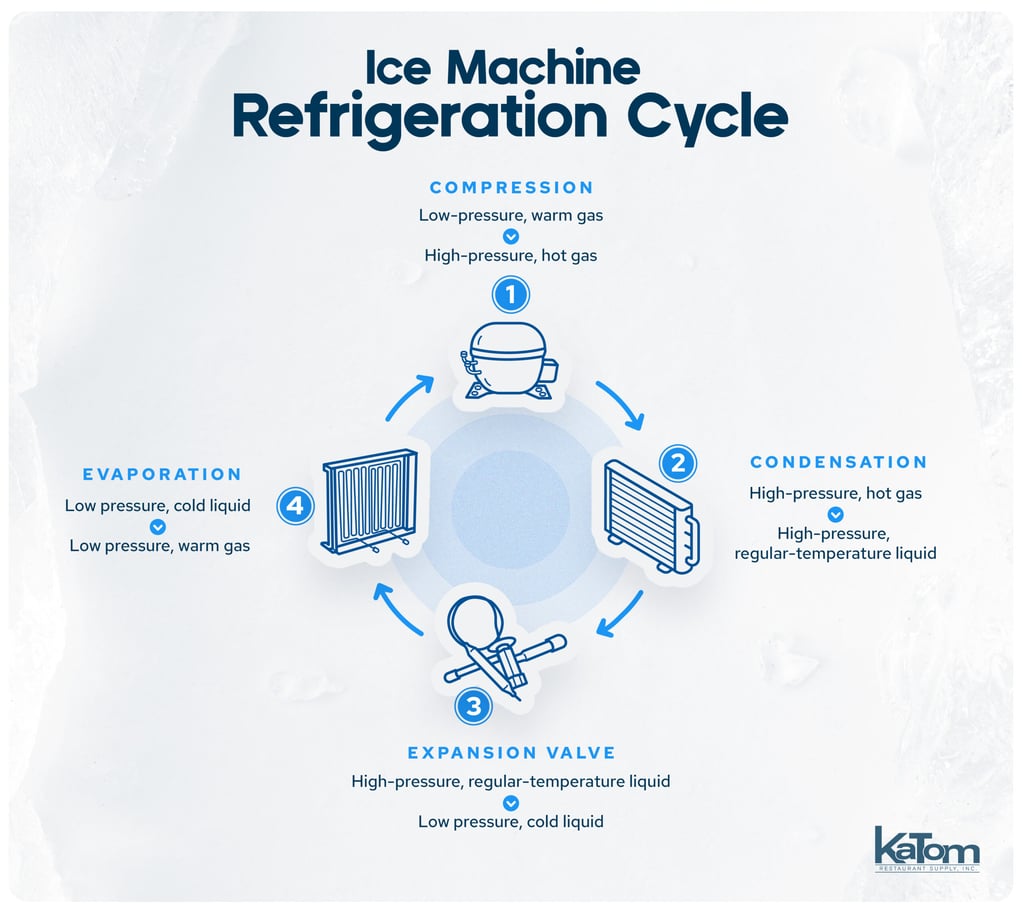
The Four Stages of the Refrigeration Cycle
The refrigeration cycle works in a closed system charged with a refrigerant. In commercial machines, common refrigerants include R290, R134a, R404a, and others, though some refrigerants have been phased out due to legislation dictating the use of R290 and other hydrocarbons beginning in 2026. These cooling agents have low boiling points, enabling them to absorb and release heat efficiently.
1. Compression
Compressors drive refrigeration systems. They receive low-pressure, warm refrigerant gas from the evaporator and compress it, which decreases the gas's volume and increases its temperature.
2. Condensation
The hot refrigerant gas flows into small condenser coils, where heat transfers to flowing water or ambient air, depending on the cooling system. As the heat is removed from the machine, the cooled gas condenses into a high-pressure liquid.
3. Expansion Valve
This high-pressure liquid exits through a tiny expansion valve, causing a rapid drop in pressure. This pressure change allows part of the liquid refrigerant to vaporize, quickly reducing its temperature well below water's freezing point.
4. Evaporation
As the chilled refrigerant enters the evaporator and travels through its coils, it absorbs heat from the water flowing over the plate and gradually freezes it.
How Ice Machines Produce Different Types of Ice
Ice machine evaporators are designed in various configurations to produce different ice shapes. Most units run or spray water continuously over a metal grid connected to the evaporator, while some evaporators are wrapped around a cylindrical tube with water inside.
"Cube ice is typically done on a vertical plate, and the water runs across that plate…If we're making gourmet ice, instead of making the ice on a vertical, we make it on a horizontal." — David Hyttel, General Manager & Vice President of Sales, ITV Ice Makers
Why the Refrigeration Cycle Matters
Understanding how the refrigeration cycle works helps with equipment selection, maintenance, and troubleshooting. Common signs of refrigeration system malfunction include:
- Equipment not reaching the correct temperature
- Reduced ice production or soft ice
- Frost or ice buildup on evaporator coils
- Excessive heat near the condenser
- Unusual compressor noise
- Higher energy usage
Ice machine cleaning and maintenance help keep refrigeration equipment working. Cleaning dust and debris from condenser coils helps them dissipate heat efficiently, and regularly cleaning and descaling evaporators ensures optimal contact between the water and the freezing surface. It's also important to clean water dispensing tubes. As Hyttel says, "Those holes start to get plugged up and don't distribute water efficiently across the evaporator, so then you lose ice production." Advanced maintenance may include inspecting the refrigerant charge and ensuring the expansion valve is working properly.
Explore Commercial Ice Machine Types & Configurations
KaTom offers commercial ice makers for many types of operations, including undercounter, modular, and dispensing machines in various sizes. Explore KaTom's catalog today to find an ice system that fits your production needs.
Frequently Asked Questions
How does the refrigeration cycle work?
The refrigeration cycle works by circulating refrigerant through a compressor, condenser, expansion valve, and evaporator. The refrigerant absorbs heat from the refrigerated area and releases it outside the system.
Does refrigeration create cold air and ice?
In scientific terms, refrigeration doesn't create cold. It removes heat from the air or water, causing the temperature to drop.
What part of the refrigeration cycle makes things cold?
The evaporator cools the refrigerated area by absorbing heat from the air, water, or product inside the equipment.
How does water become ice?
Water becomes ice when heat is removed until it reaches its freezing point of 32 degrees Fahrenheit. In an ice machine, the evaporator removes heat from the water, allowing ice to form on the freezing surface.
Why does the back or bottom of refrigeration equipment feel warm?
In air-cooled units, the condenser fan dispels heat removed from inside the refrigerator, freezer, or ice machine, along with heat generated during compression. Water-cooled units still emit some heat.
