Converting Measurements by Volume & Weight
A longstanding debate among bakers has been whether it's better to measure ingredients by volume or by weight. Traditionally, measuring cups and spoons are used in North America, while scales are more common overseas. Where did this disparity come from, and what difference does it make when cooking? After learning more about the history of ingredient measuring and the different tools available today, use KaTom's recipe converter charts to create consistent results in any kitchen.
The Mother of the Level Measurements
For most of history, a kitchen scale was a big investment. Mechanical, balance-style scales were the only design available, so a set of weights would be needed in addition to the scale itself. For many home cooks, this was cumbersome, impractical, and too expensive to bother with. As a result, most recipes were written with very general measurements, such as a "good amount" or "pinch." Obviously, this could result in a big variation in results.
All of this began to change in 1896 when Fannie Farmer published The Boston Cooking School Cookbook.1 This cookbook gave ingredient amounts by volume, using measurements created by dividing a pint into increasingly smaller portions.2 Farmer, who soon became known as "The Mother of Level Measurements," was a huge advocate for standardized measuring, and measuring cups and spoons soon became the standard equipment in American kitchens. They have largely stayed there, despite advances in kitchen scale designs, making them much more affordable and easy to use.
Weight vs. Volume
Modern bakers have easy access to both measuring cups and scales, so the decision of which to use is based both in tradition and practicality. Many home bakers use measuring cups because it is what they grew up using and familiarity makes that choice seem easier. While volume measurements are less accurate than weight, the batches in a home kitchen are usually small enough that a bit of inaccuracy isn't enough to have a huge effect on the final product.
Advocates of weighing their ingredients point out that in addition to being more accurate, their method results in fewer dishes to wash. Modern scales have a "tare" feature, which resets the scale to zero. This means that after each ingredient is added, you can reset the scale to zero and add the next ingredient to the same bowl. Weight is also a lot more constant than volume; product density doesn't matter with weight, so you don't have to worry about how tightly packed your flour or brown sugar is, and altitude won't affect the measurement.
Equipment
Whether you decide to use measuring cups or a kitchen scale, you'll have a few choices of what type of equipment to buy. Measuring cups are available in plastic, metal, glass, and silicone. Metal measuring cups are durable but may be susceptible to rust, and the inability to see through the material means, in most cases, a separate cup for each measurement is needed. Plastic, silicone, and glass enable you to see through the material, so they can make use of measurement markings on the sides. Glass is the most fragile, but retains its clarity the best and isn't prone to clouding or staining over time like plastic and silicone.
There are also a few types of kitchen scales. Traditional baking scales are made similar to how they were for much of history, using a balance and weights to determine the weight of the food. This simple design is preferred by some, as you never have to worry about the scale becoming inaccurate or replacing dead batteries.
Analog scales feature a platform over an analog dial. The dial may have measurements in grams or ounces, and some may have both, with one set of measurements inside the other. Digital scales are the most common type found in modern kitchens, due to their tare function that makes measuring multiple ingredients into the same bowl simple. Digital scales have a round or square flat platform, with the weight readout either built into the base or as a separate piece that attaches to the platform with a cord. With either of these scale types, it's important to note if it measures in grams or ounces, what increments it measures in, and the maximum capacity.
Kitchen Conversions
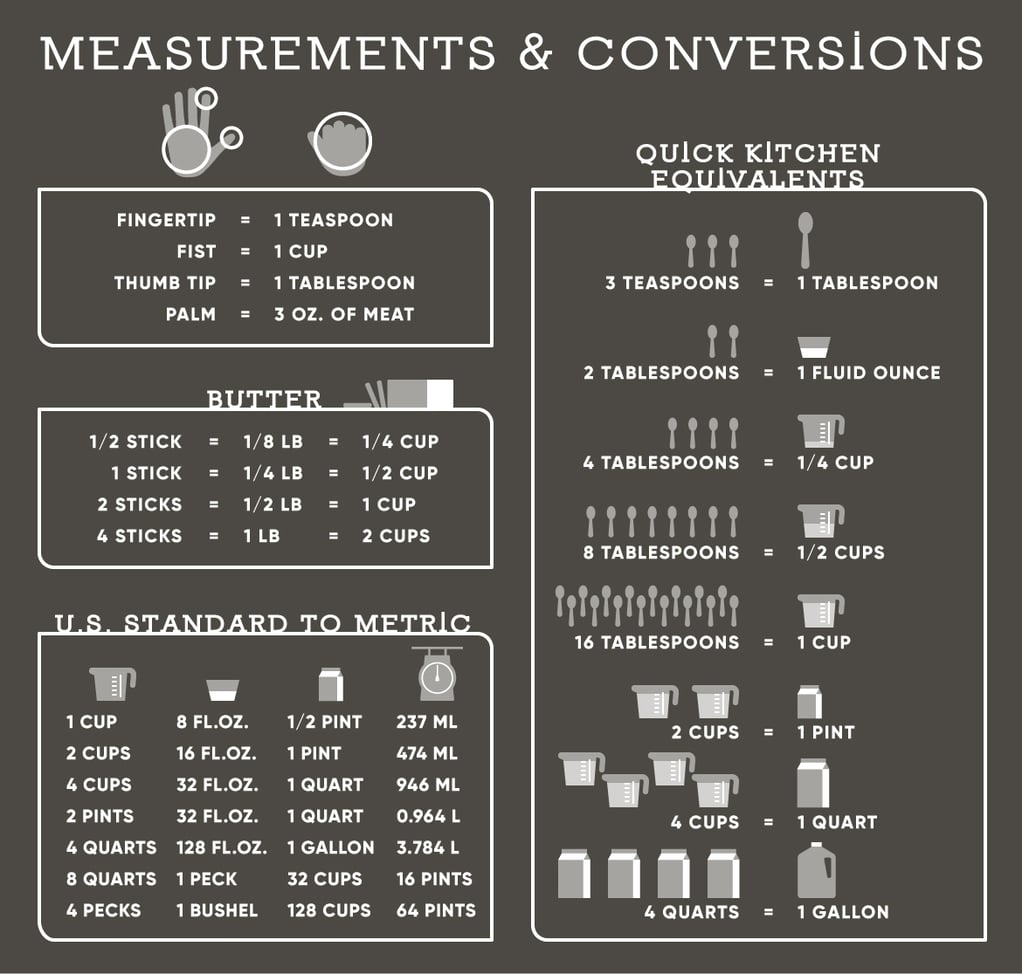
Whether you decide to measure by volume or weight, chances are you'll need to convert a recipe from one to the other at some point. Even within volume and weight, differences between metric and U.S. customary units can complicate matters for some recipes and inaccurate kitchen conversions can lead to disastrous cooking results. For your convenience, we've created recipe converter charts to make these calculations quick and easy.
| Ingredient | Volume | Weight |
| Butter | 1 cup | 226 grams |
| All-purpose Flour | 1 cup | 130 grams |
| Cake Flour | 1 cup | 120 grams |
| Whole Wheat Flour | 1 cup | 130 grams |
| Potato Flour | 1 tbsp.1/2 cup | 12 grams80 grams |
| CornstarchCorn flour | 1 tbsp. | 10 grams |
| Ground AlmondsAlmond MealAlmond Flour | 1 cup | 90 grams |
| Cornmeal | 1 cup | 120 grams |
| Granulated White Sugar | 1 cup | 200 grams |
| Lightly Packed Brown Sugar | 1 cup | 210 grams |
| Confectioner's SugarPowdered SugarIcing Sugar | 1 cup | 120 grams |
| Chocolate Chips | 1 cup | 170 grams |
| Cocoa Powder(may vary by brand) | 1 tbsp.1 cup | 6 grams100 grams |
| Graham Cracker Crumbs | 1 cup | 100 grams |
| Old-fashioned Rolled Oats | 1 cup | 95 grams |
| Teaspoons/Tablespoons | Cups |
|---|---|
| 2 tsp. | 2/3 tbsp. |
| 3 tsp. | 1/8 cup |
| 4 tsp. | 1/4 cup |
| 5 1/3 tbsp. | 1/3 cup |
| 8 tbsp. | 1/2 cup |
| 12 tbsp. | 3/4 cup |
| 32 tbsp. | 2 cups |
| 64 tbsp. | 4 cups |
| U.S. Customary Weight | Metric Weight |
|---|---|
| 1/2 ounce | 14.3 grams |
| 1 ounce | 28.3 grams |
| 2 ounces | 56.7 grams |
| 2.6 ounces | 75.6 grams |
| 4 ounces | 113.4 grams |
| 6 ounces | 170 grams |
| 1 pound | 453.6 grams |
| 2 pounds | 907 grams |
| U.S. Customary Volumes | Metric Volume | ||
|---|---|---|---|
| 1 cup | 8 fluid oz. | 1/2 pint | 237 ml |
| 2 cups | 16 fluid oz. | 1 pint | 474 ml |
| 4 cups | 32 fluid oz. | 1 quart | 946 ml |
| 2 pints | 32 fluid oz. | 1 quart | 0.964 liters |
| 4 quarts | 128 fluid oz. | 1 gallon | 3.784 liters |
| 8 quarts | 1 peck | 32 cups | 16 pints |
| 4 pecks | 1 bushel | 128 cups | 64 pints |
| 1 gallon | 128 fluid oz. | 16 cups | 4 quarts |
| Sticks | Pounds | Cups |
|---|---|---|
| 1/2 stick | 1/8 pound | 1/4 cup |
| 1 stick | 1/4 pound | 1/2 cup |
| 2 sticks | 1/2 pound | 1 cup |
| 4 sticks | 1 pound | 2 cups |
| Portion | Conversion |
|---|---|
| A palm/deck of cards | 3 oz. of meat |
| A thumbprint | 1 teaspoon |
| 3 thumbprints | 1 tablespoon |
| 1 thumb | 25 g of cheese |
| A fist | 1 cup |
References
- Farmer, Fannie Merritt Feeding America. Accessed October 2015.
- Measurements Cook's Info. Accessed October 2015.
- Weight Vs. Volume Measurement Joy of Baking. Accessed October 2015.
