
Preparing for COVID-19 on Campus
The COVID-19 pandemic that began impacting the United States in the early months of 2020 forced many colleges to adjust their spring semesters for the safety of faculty and students. Some suspended classes temporarily before ultimately taking them online, passing work-from-home policies for university administrators and staff, and canceling commencement ceremonies and other events. With the Fall semester rapidly approaching, educational institutions hoping to resume in-person learning are creating sanitation plans to provide an on-campus experience while minimizing risks to the health and safety of their students.
Top Campus Concerns to Address
Current CDC guidance regarding the coronavirus disease1 indicates the virus has a "person-to-person spread." This means coughing, sneezing, and talking can create respiratory droplets that are inhaled by other individuals standing within 6 feet. Because of this, CDC recommendations for preventing COVID-19 spread include:
- Wearing a cloth face covering in public spaces when social distancing (maintaining a distance of at least 6 feet between individuals) is not feasible;
- Frequently washing hands with soap and water or applying hand sanitizer when soap and water are not available;
- Sanitizing high-traffic touchpoints, such as door knobs and desks, on a consistent and routine basis.
In light of the ongoing pandemic, our goal is to assist colleges and universities with student and faculty safety when they return to campus by providing cost-effective solutions designed to address concerns about person-to-person spread on college campuses. Below, you can learn more about what products can be included in a customized sanitation plan from KaTom.
Liquid & Gel Hand Sanitizer for Public Spaces & Personal Use
Ensuring students, faculty, and other employees have access to hand sanitizer promotes hand decontamination throughout the day in spaces without soap and water, including classrooms, offices, and hallways. We offer liquid and gel hand sanitizer and dispensing options for any application.
Why use liquid hand sanitizer?
Liquid sanitizer has a thinner consistency than the gel sanitizer you might be used to using in public spaces, but this consistency provides the best total coverage of the hands. A 2002 study of hand gel sanitizers2 found that liquid spray-type sanitizers – also called "hand rinses" – are the most effective option. However, they should be paired with a spray-type dispenser to avoid the mess created by dispensing liquid sanitizer from a pump-style dispenser.
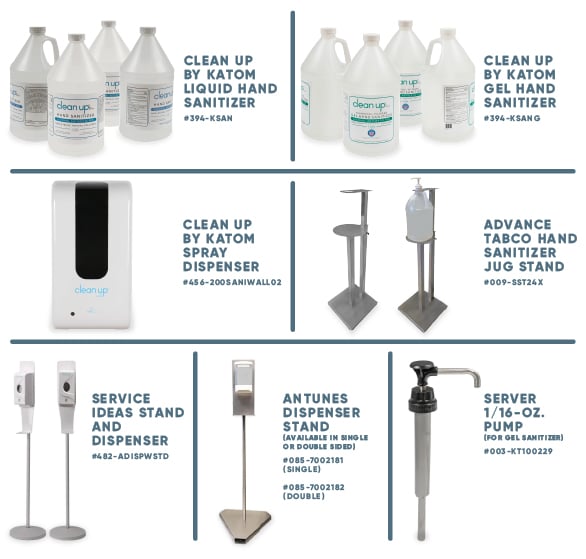
Our spray-type sanitizer…
- Is made in Tennessee and readily available because we control the supply chain
- Follows the FDA/WHO formula for effectiveness against COVID-19 and influenza
- Has been FDA certified
- Contains over 80 percent food-grade ethanol for 99 percent effectiveness
- Includes glycerin and xanthan gum to keep hands soft and avoid drying them out
- Provides the best total coverage of the end user's hands
- Can be paired with a wall-mounted spray-type dispenser or spray-type dispensers mounted on a single- or double-sided stand
The second option, a gel hand sanitizer, is made with 70 percent ethanol and the addition of isopropyl alcohol to provide a clinical aroma that's more familiar to the end user. Our blend includes the right amount of thickening agent to create the gel-like consistency users expect while preventing a "tacky" feeling on the skin after use.
Why use gel sanitizer?
Although liquid-type sanitizers may be more effective, gel sanitizers are still a great option for spaces that need to offer a hand sanitization option but can't provide soap and water. Ultimately, this type of hand sanitizer creates an experience that students and faculty will be accustomed to, because its thicker consistency can be portioned out from a pump-style dispenser and is reminiscent of sanitizers they've used in the past.
Our gel sanitizer…
- Is made in Tennessee and readily available because we control the supply chain
- Has been FDA certified
- Contains over 70 percent food-grade ethanol for 99 percent effectiveness
- Includes glycerin to keep hands soft and avoid drying them out
- Provides a familiar sanitizing experience
- Can be dispensed directly from the 1-gallon jug with a 1⁄16-ounce portion pump that can be screwed on the top
How can I incorporate hand sanitizer into my campus?
Hand sanitizer dispensers should be placed in several accessible locations throughout your facilities. Wall-mounted units are the most cost-effective option but stands make it possible to install sanitizing stations near doorways.
To ensure students have access to sanitizer at all times, colleges and universities may wish to distribute individual sanitizer spray bottles and create sanitizer refill stations to place throughout campus, creating an on-the-go solution that students can replenish as needed. Our team can work with you to find the best solution for your needs and budget.
Protect Students With Cloth Masks
Whether students are walking around campus or participating in classroom learning, social distancing will be very difficult if not impossible to maintain in all parts of campus. By distributing one free cloth face mask to each student and requiring them to be worn in public spaces, colleges and universities can help prevent the person-to-person spread of COVID-19 and adhere to CDC recommendations.
How Else Can We Help?
Our team is ready and able to assist institutions of higher learning with their evolving sanitation needs during this challenging time. Contact KaTom for more information about a customized sanitation plan and quote for your college or university.
Resources
- How COVID-19 Spreads. Centers for Disease Control and Prevention. Accessed July 2020.
- Limited efficacy of alcohol-based hand gels. The Lancet. Accessed July 2020.
