How Much Water Does a Commercial Ice Maker Use?
An air-cooled commercial ice machine typically uses 15 to 25 gallons of water to produce 100 pounds of ice. Actual water consumption varies based on ice type, production capacity, energy efficiency, and maintenance, among other factors. Water-cooled ice machines may consume 100 to 200 gallons of water per 100 pounds of ice. The right ice machine for your needs depends on space, local regulations, and energy efficiency.
With more than 38 years of experience serving the foodservice industry, KaTom helps operators evaluate ice machine performance, operating costs, and installation requirements to choose equipment that meets their production needs.
Key Takeaways
- Air-cooled units are typically cheaper and more water efficient
- High-volume ice production means more water usage
- Water usage varies by ice types
- Water-cooled machines aren't eligible for ENERGY STAR certification
- Air-cooled machines are dependent on ambient room temperature
- Poor maintenance routines may increase water waste
- Air-Cooled vs. Water-Cooled
- Ice Machine Size & Production Capacity
- Ice Type
- Choose an ENERGY STAR-Certified Ice Maker
- Ambient Temperature
- Maintenance Practices
- Tips for Reducing Your Ice Maker's Water Usage
Water Usage Factors
Air-Cooled vs. Water-Cooled
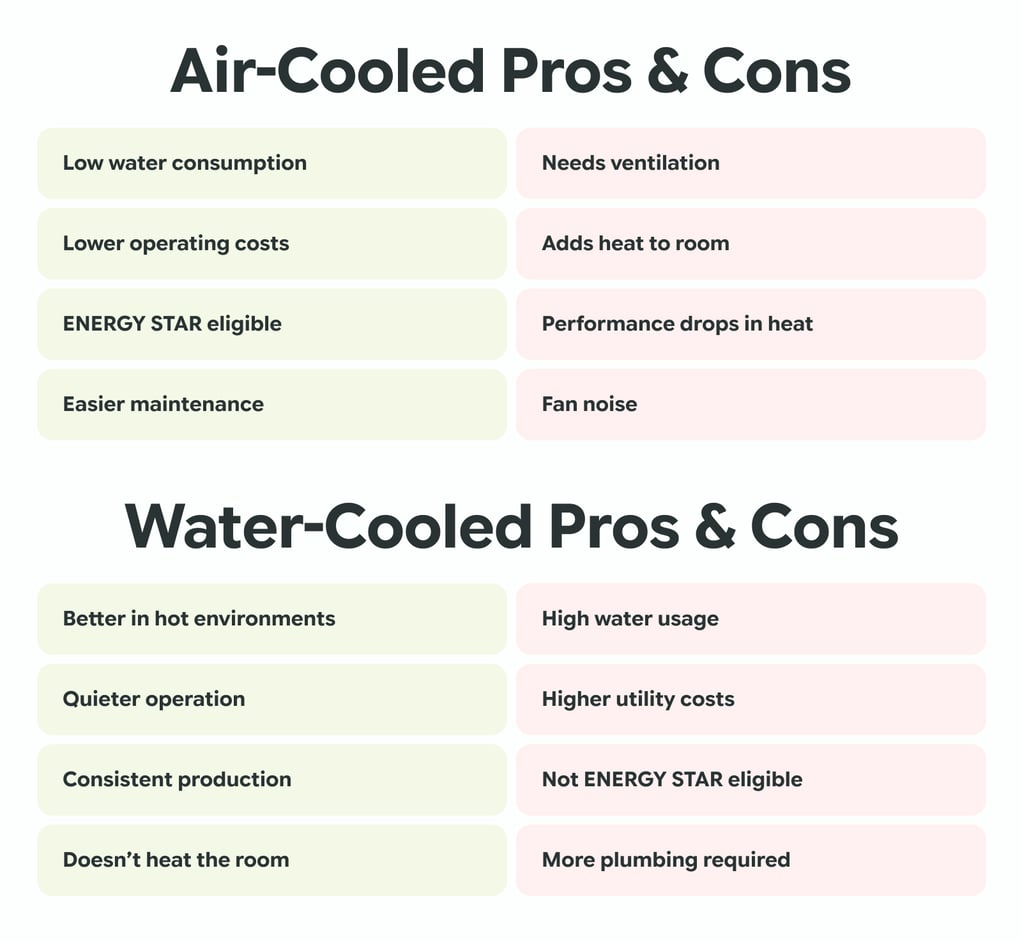
Air-cooled ice machines use a fan to pull ambient air across condenser coils to remove heat, while a water-cooled machine uses a continuous flow of water to absorb and remove heat.
Air-cooled machines use significantly less water and have lower water-related utility costs than water-cooled models. While they may use more electricity than some alternatives, they eliminate the ongoing expense associated with high water consumption. Depending on the model, ENERGY STAR-certified air-cooled ice machines use about 15 to 25 gallons of water per 100 pounds of ice production.1
Water-cooled units can be efficient from a refrigeration standpoint, but they require a continuous supply of water for cooling. In some cases, they may use more than 100 gallons of water to produce 100 pounds of ice. Water expenses can significantly affect the long-term utility costs due to water consumption, so these units are generally only recommended for operations with access to a closed-loop water system in their building.
- Higher production capacity increases overall water usage
- Larger machines are often more water efficient per pound of ice
- Cooling method plays a major role in water consumption
Ice Type
Because different ice-making methods use water in different ways, the type of ice a machine produces can influence water consumption. Some machines operate continuously, while others produce ice in batches and periodically discharge water to reduce mineral buildup.
According to the U.S. Environmental Protection Agency (EPA), commercial ice machines are classified as either batch-type or continuous-type systems. Batch-type machines produce cube ice, which is created through repeated freezing cycles that help remove impurities and trapped air, resulting in clear, dense cubes commonly used in beverages. To maintain ice clarity and limit mineral buildup, cube ice machines periodically discharge concentrated water, which increases overall water consumption.
Flake and nugget ice machines operate differently. Because the ice is not repeatedly rinsed during production, these machines can produce ice continuously and typically generate less wastewater. Flake ice is commonly used in food displays, seafood cases, and salad bars where ice appearance is less important than temperature control. Nugget ice is compressed into a softer, chewable form that is popular in beverages and frequently used in healthcare environments. Producing clear, high-quality cube ice requires additional water management, though actual water consumption varies by machine capacity, production rate, and design.2
Ice Type / Machine Water Use (gallons per hour) Estimated per 100 lbs. of ice Cube ice maker 2 to 5 gal. per hour ~15 to 25 gal. Flake ice maker 3 to 7 gal. per hour Higher, continuous flow Nugget ice maker 3 to 6 gal. per hour Medium-high Countertop and undercounter 21/2 to 3 gal. per hour ~10 to 13 gal.
Choose an ENERGY STAR-Certified Ice Maker
Operators may save on long-term energy costs by purchasing an ENERGY STAR-certified ice machine. Air-cooled batch- and continuous-type ice makers are eligible for equipment rebates, while water-cooled ice makers are ineligible. ENERGY STAR machines may reduce water usage 20 percent. Although ENERGY STAR models may carry a higher upfront cost, utility savings can help offset the initial investment over time.3
Ambient Temperature
Air-cooled machines are more susceptible to high ambient temperatures. Production drops drastically as the ambient room temperature rises. The optimal temperature is 70 degrees Fahrenheit, and if the temperature rises above 90 degrees Fahrenheit, ice production may fall.
"If your ambient temperature in the wintertime is 70 degrees, but then the summer comes and it's 90 degrees, it's going to affect your production of that machine," Hyttell said.
To maintain energy efficiency, ensure at least six inches of clearance around the machine's air intake and vents. Don't locate ice makers near heat-producing appliances.
Maintenance Practices
Poor maintenance on an ice maker can lead to longer run times, scale buildup, and increased water waste. Hard water leaves mineral deposits on internal components, insulating the evaporator and forcing the machine to use more time, energy, and water to produce the same amount of ice. High mineral content can also trigger more frequent purge cycles, causing additional water to be discharged. Regularly changing water filters, removing scale, and cleaning condenser coils can help maintain efficiency and reduce unnecessary water consumption.
Other maintenance steps to follow:
- Follow the manufacturer's recommendations for proper care
- Close the lid to keep cool air in the machine
- Check for leaks
- Consider installing a timer to cut down production during non-operating hours
"Extreme heat can push an ice machine to its max. A dirty machine reduces its capacity, turning a 500-pound machine into a 350-pound one. Regular cleaning keeps it running efficiently." — Dewayne Lane, Owner, Big D's Heating and Air
Tips for Reducing Your Ice Maker's Water Usage
Opt for an Air-Cooled Ice Machine
Choose an ENERGY STAR-Certified Ice Maker
Routinely Clean and Maintain Your Ice Maker
Replace Water Filters Regularly
Size Your Ice Maker Appropriately
Air-cooled machines use less water than water-cooled models because they rely on air rather than water to remove heat during the cooling process.
"Water-cooled units are rare and usually only for places like hospitals or cruise ships with a chilled water loop; otherwise, air cooled is the standard," said Scott Bingham, Director of Marketing at Follett Products LLC.
Ice machines certified by ENERGY STAR use less water and energy by design than standard ice makers. Investing in an ENERGY STAR-certified ice maker naturally brings down your utility costs over the life of the unit.
Keeping the condenser clean and performing routine maintenance also helps the machine operate efficiently, reducing unnecessary water waste. Scale buildup and neglected components can increase water usage; check out our ice maker maintenance guide to help improve your water efficiency.
Keeping your water filter clean ensures optimal water flow and maintains peak ice production efficiency. Conversely, clogged or overdue filters can strain the machine's components and lead to unnecessary water usage.
"Water filters are essential," Lane said. "Minerals like calcium and iron, or even airborne particles, can clog components. Using a filter reduces buildup and ensures better water quality for ice production."
Choosing an ice maker sized for your actual production needs ensures you only use the amount of water you absolutely need. Oversized machines often produce excess ice that melts before it can be utilized, resulting in unnecessary water consumption and higher utility bills.
"The water cooled is definitely going to affect water usage because instead of using air to cool the refrigeration, you're using water." — David Hyttel, VP of Sales, ITV Ice Makers
Ice Machine Size & Production Capacity
Production capacity affects water consumption in two ways: the water used to create ice and the water used to cool the machine. When selecting a machine, operators should estimate their peak daily ice demand and choose a model that can meet production needs. Sizing an ice maker for your actual production needs can help minimize wasted water. Oversized machines may produce excess ice that melts before use, resulting in unnecessary water consumption. The relationship between capacity and water use depends on several factors.
Shop Ice Machines at KaTom
Explore KaTom to find ice machines or contact our foodservice equipment specialists to choose the best fit for your operation. Ice makers differ in installation and performance, so the right choice depends on your kitchen setup. With more than 38 years of experience serving the foodservice industry, KaTom is a trusted resource for commercial equipment.
References
- Save Water with Air-Cooled Ice Machines. Los Angeles Department of Water & Power. Accessed June 2026
- Commercial Kitchen Equipment: Commercial Ice Makers epa.gov. Accessed June 2026
- Commercial Ice Makers energystar.gov. Accessed June 2026


