What are the 5 Mother Sauces?
When it comes to French cuisine, it's all about the sauce – it famously goes over everything from pastas and soups to eggs on toast. French cooks realized the importance of a good sauce early, way back in the Middle Ages when there were already hundreds of sauces they utilized to set their cuisine apart from the rest. However, only four sauces were considered to be especially pertinent to the cuisine, according to the founder of the "mother sauces," chef Marie-Antoine Carême. It wasn't until culinary great Auguste Escoffier came along that the five mother sauces we know today were modernized.
French Cuisine's Founding Fathers
Carême began creating an extensive list of sauces during the early 19th century. The mother sauces identified by Carême's were espagnole, allemande, velouté, and béchamel, which could be used to prepare a variety of petites sauces, or smaller sauces.
Almost a century later, Auguste Escoffier took Carême's list and refined it throughout four editions of Le Guide Culinaire — a codification of 19th century French restaurant cuisine – and the abridged English version titled A Guide to Modern Cookery. In these texts, Escoffier explains how to make the 5 mother sauces: béchamel, espagnole, hollandaise, velouté, and tomate.
Cooking with the 5 Mother Sauces
French cuisine's five mother sauces are:
- Béchamel, a white sauce that is often used as a base for many cheese sauces.
- Espagnole, a brown sauce that works as a base for many sauces, such as demi-glace.
- Hollandaise, an emulsion of melted butter with egg yolk and lemon juice.
- Velouté, a white sauce that has wide number of derivative sauces, such as white wine sauce.
- Sauce tomate, or tomato sauce, that can be combined with a variety of ingredients to make condiments such as ketchup and hot sauce.
Béchamel
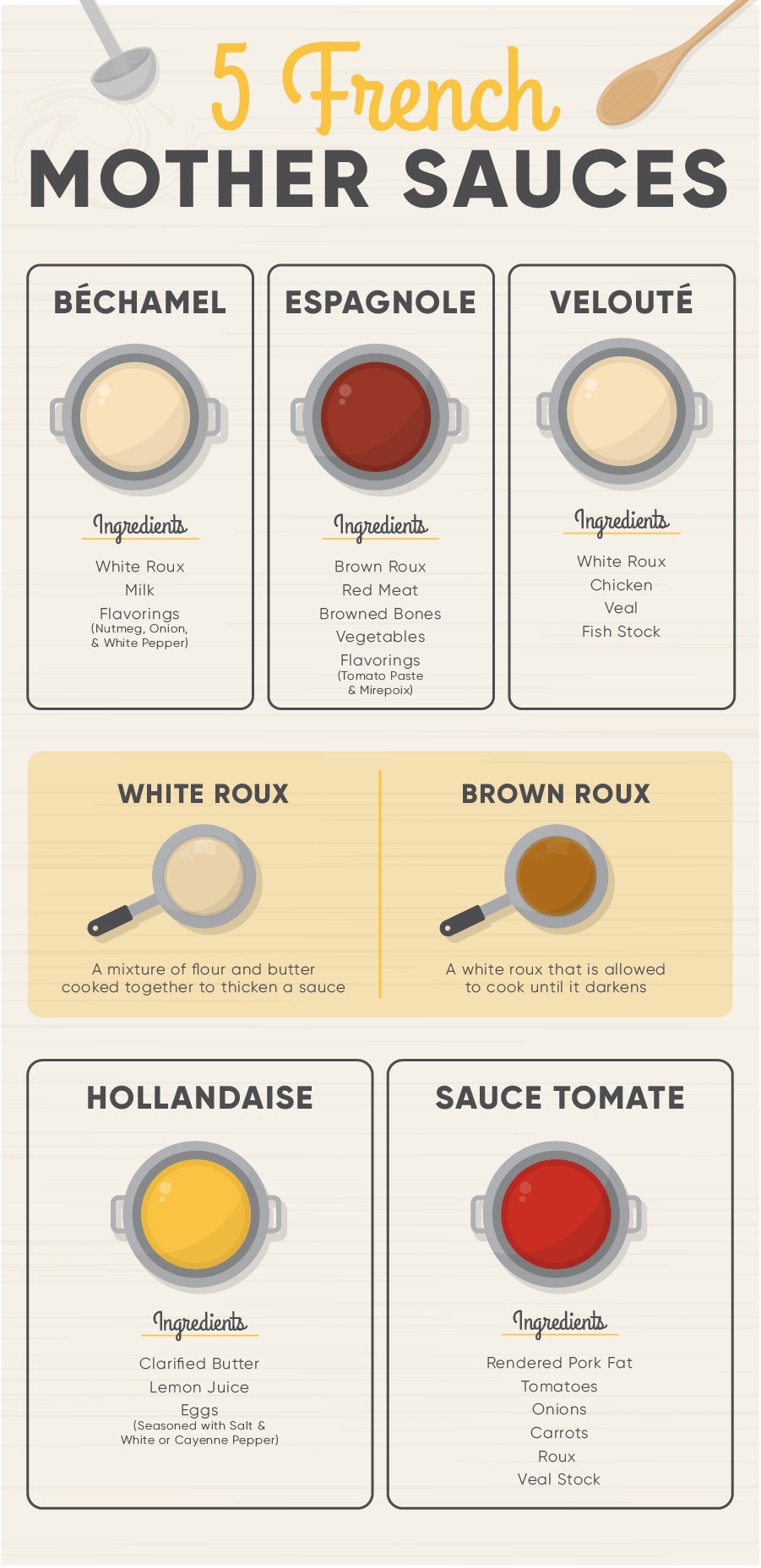
One of the more basic sauces, béchamel is a white sauce used as a base for more complex sauces, such as crème sauce and cheesy Mornay. Béchamel is made with a base of white roux – a mixture of flour and butter that is cooked and used to thicken the sauce. The roux is then mixed with milk, and paired with flavorings such as nutmeg, onion, and white pepper.
In the past, béchamel was also made with cream and eggs. The rich sauce was quite popular with royals, and it wasn't until the 19th century that Escoffier simplified the recipe to contain only three ingredients. It is typically served with eggs or fish and can be used to make lasagna, scalloped potatoes, and many other dishes.
Made with Béchamel: Lasagna Bolognese
Espagnole
A brown sauce, espagnole is heavy and simple to make. To make espagnole you must combine brown stock – such as beef or veal stock – with brown roux, which is simply a white roux that has been cooked longer and allowed to darken. Pieces of red meat, browned bones, and vegetable are also added. As the meat and bones cook, the connective tissues start to dissolve, forming what is essentially meat gelatin Flavorings like mirepoix and tomato puree can be added to enhance the flavor.
Espagnole is rarely directly added to food, as it has quite a strong taste. Typically, it is used to create other sauces, such as demi-glace, Sauce Robert, and bordelaise, but some prefer to pour espagnole over steak and other red meat.
Made with Espagnole: Beef tenderloin with mushrooms
Hollandaise
Hollandaise sauce gained popularity by being a key ingredient in Eggs Benedict, which you've probably seen on your favorite restaurant's brunch menu. Carême's original categorization of the French sauces included allemande, a stock-based sauce with lemon juice and egg; Escoffier's list left out allemande in favor of hollandaise sauce.
Hollandaise is an emulsion – a mixture of two different liquids that would usually not mix together – and is made by combining melted butter, lemon juice, and egg yolks. Some chefs prefer to use clarified butter, or butter that has had its milk solid removed. The mixture is then whisked at low temperatures, and can be seasoned with salt and pepper. Hollandaise sauce is used as a foundation for Béarnise sauce, Dijon sauce, and Maltaise sauce.
Made with Hollandaise: Eggs Benedict
Velouté
The last and easiest white sauce to make, velouté is savory and buttery. To make velouté, thicken a light stock made from either chicken, veal, or fish, and add white roux to the mixture. Velouté stands out as one of the most versatile of the five mother sauces and can be used to create allemande sauce, gravy, Normande sauce, and many more. It is also often served alongside seafood and poultry dishes.
Made with Velouté: Fish Velouté
Sauce Tomate
Just like tomato sauces originating from other styles of cuisine, sauce tomate uses tomatoes as its main ingredient, while mixing in several other ingredients. To make sauce tomate, combine rendered pork fat taken from salted pork belly with a blended mixture of tomatoes, onions, and carrots. After roux and veal stock are also added, the mixture must be simmered in an oven at medium heat for 2 hours. Garlic, salt and pepper, sugar, and other seasonings may be added to enhance the taste. Sauce tomate is most commonly served with pasta, chicken, and dumplings.
Made with Sauce Tomate: Gnocchi with sauce tomate and mozzarella
