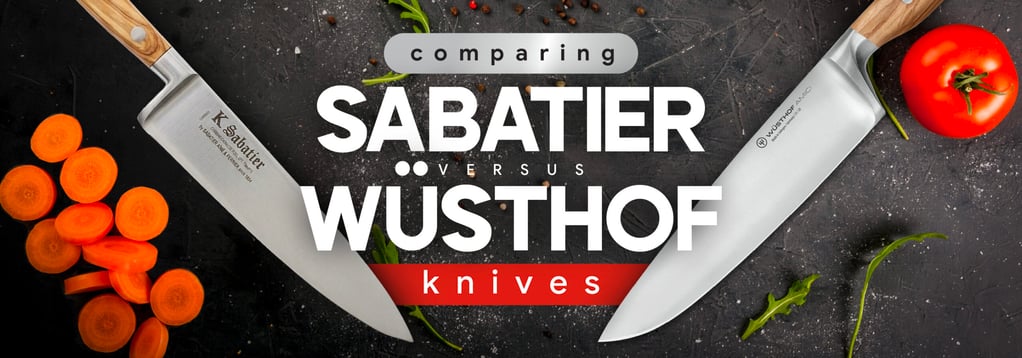
Sabatier vs. Wüsthof Knives
Sabatier and Wüsthof are two European knife brands manufacturing forged knives for professional use. Sabatier’s classic profiles and carbon steel options are suited for skilled users who want a thin, carbon steel blade and are prepared to maintain it properly. Wüsthof knives are built for sturdy, versatile performance across repeated prep tasks, making them a great fit for high-volume kitchens.
Sabatier vs. Wüsthof: Comparison Snapshot
| Category | Sabatier | Wüsthof |
|---|---|---|
| Overview | Forged French knives with carbon steel options | Forged German knives made for heavy-duty use |
| Typical Price Range | $$$ | $$$$ |
| Strengths | Forged construction, carbon steel options | Broad assortment and ergonomic design |
| Considerations | Carbon steel knives require increased maintenance | Heavier feel, less edge retention |
| Best For | Finesse operators seeking lightweight knives | Operators seeking durable knives for heavy-duty prep |
About Sabatier
Founded in 1834 in France, K Sabatier’s workshops are located in the town of Thiers, the "World Capital of Cutlery". An eighth-generation family cutlery business, the company takes a unique approach to knife manufacturing. Steel is heated to 1,050 degrees Celsius and is cut, quenched, and ground to give a cutting angle to the edge. Each employee in a Sabatier workshop specializes in either polishing, assembly, or finishing.
It’s important to note the "Sabatier" name is not trademarked, so multiple companies in Thiers use it legally. For the family-owned company discussed here, the brand name is "K Sabatier", and the brand’s knives are stamped with a "K".
Key Features:
- Precision-forged construction
- Carbon steel takes a razor-sharp edge and sharpens easily
- Lightweight, thin blades enable precise, fine cuts
About Wüsthof
Wüsthof is a family-run operation founded in Solingen, Germany, often called "The City of Blades", in 1814. Wüsthof knives are known for exceptional durability and cutting performance. The brand’s Classic series, introduced in the 1880s, includes a wide blade selection and a full-bolster, three-rivet design. A 54-step manufacturing process is used to turn a piece of WÜSTHOF steel—a mix of chrome, vanadium, molybdenum, and stainless steel—into a finished knife.
Key Features:
- Precision-forged construction
- Precision Edge Technology (PEtec) for increased edge retention
- Hollow edge design prevents food from sticking to the blade
Key Differences Explained
Performance
Wüsthof performs well in high-volume kitchens because its durable stainless steel knives deliver consistency. Wüsthof’s Classic chef’s knife is forged from a single piece of Wüsthof steel and hardened to 58 Rockwell, giving operators a predictable balance of edge retention, toughness, and stain resistance. Sabatier’s stainless steel blades are hardened to 55 to 58 HRC, while carbon steel options are hardened to 54 to 56 HRC. These are popular among experienced cooks, especially with carbon steel blades that sharpen easily and develop a responsive cutting feel.
Durability and Edge Retention
WÜSTHOF steel is heat treated for corrosion resistance, and the unique hardness of the material significantly reduces wear on the blade. PEtec technology utilizes a laser-assisted sharpening process to ensure each knife has a refined edge. Sabatier’s carbon-steel knives have exceptional cutting power and generally hold their edge 10 to 15 percent longer than stainless steel knives, though they’re more sensitive to improper sharpening and are not dishwasher safe.
Price and Value
Wüsthof knives are positioned at a higher, more predictable price point, while Sabatier knives are generally available at lower price points. Sabatier’s carbon steel knives sit at a lower price point than stainless steel options from either brand, making them great for chefs looking for entry-level knives.
Which Knife Brand Is Best for You?
Wüsthof is a strong fit for operations needing durability and consistency for repeated prep. Sabatier suits cooks seeking carbon steel options that hold edge retention and support finer, more accurate cuts.
| Scenario | Best Choice | Why |
|---|---|---|
| Steakhouse | Wüsthof | Heavy-duty knives easily cut through meat, cartilage, and bone |
| Culinary School | Wüsthof | Standardized knives support repeated instructions and replacement |
| Fine Dining | Sabatier | Designed for classical French techniques requiring precise cuts |
| Sushi Bar | Sabatier | Refined carbon steel edge enables precision cuts with minimal tearing |
Wüsthof supports commercial kitchens by offering durable forged construction perfect for repeated daily use. Sabatier requires disciplined maintenance but is a great choice for chefs prioritizing fine cuts.
Shop Wüsthof at KaTom
KaTom offers a wide selection of Wüsthof knives for foodservice operations seeking dependable cutlery. Check out KaTom’s catalog to find reliable knives at the right price for your operation.
