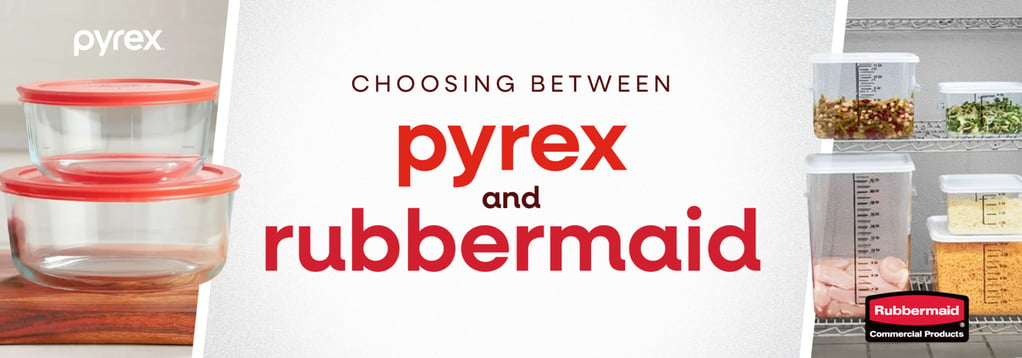
While both Pyrex and Rubbermaid products offer practical solutions for food prep and storage, the brands serve different roles in the kitchen. Though Pyrex is best known for residential glass bakeware, storage containers, and measuring tools, its durability and familiarity make its products a common sight in commercial operations. Rubbermaid's commercial line focuses on heavy-duty plastic storage containers, ingredient bins, and measuring tools built specifically for foodservice operations. Both brands provide reliable, functional options for organizing, measuring, and storing ingredients.
Comparison Snapshot
Pyrex vs. Rubbermaid
Category
Pyrex
Rubbermaid
Overview
Known for durable cooking and baking glassware; also produces measuring tools and storage containers; primarily designed for home use, but found in many commercial operations
Introduced in 1915 by Corning Glass Works, Pyrex was originally made from borosilicate glass used for railroad lanterns. Since 1998, its products have been made from tempered soda-lime glass, which is less resistant to extreme temperature shock but more resistant to dropping. Pyrex offers a lineup of casserole dishes, pie plates, mixing bowls, measuring cups, and food storage containers with lids. Pyrex also manufactures a line of scientific glassware.
Key Features:
Heat resistant up to 425 degrees Fahrenheit
Non-reactive surfaces that don't absorb stains or odors
Versatility in baking, cooking, and storage
About Rubbermaid
Rubbermaid was founded in 1933 when James R. Caldwell patented a blue rubber dustpan. The brand later merged with The Wooster Rubber Company but changed its name to Rubbermaid Incorporated in 1957. Rubbermaid manufactures a wide range of household and commercial products including trash cans, home organization systems, and foodservice items such as storage containers, ingredient bins, measuring tools, and high chairs.
Key Features:
BPA-free materials
Airtight and leak-proof seals
Impact-resistant construction
Key Differences Explained
Performance and Reliability
Pyrex and Rubbermaid differ in performance and reliability across cookware, food storage, and measuring tools. Pyrex excels in items designed for extreme temperatures, with glass bakeware, storage containers, and measuring cups that resist stains and odors while performing consistently in ovens, microwaves, and freezers. Rubbermaid offers plastic containers and measuring tools built for durability, impact resistance, and reliable performance.
Design and Ease of Use
Pyrex and Rubbermaid take different approaches to design and use in the kitchen. Pyrex emphasizes simplicity with clear glass construction for visibility and accurate measuring, though its heavier weight reduces convenience. Rubbermaid focuses on practical design; its lightweight materials, stackable shapes, and easy-grip features improve efficiency and workflow.
Maintenance and Durability
Pyrex glass is easy to clean and resists stains, odors, and warping, maintaining its appearance over time, though it can break if dropped or exposed to sudden temperature changes. Rubbermaid products are constructed for durability, with impact-resistant materials that withstand frequent handling and stacking, though they may show wear over time.
Price and Value
Pyrex primarily produces glass food storage containers, which leads to higher costs; however, the durability and oven-safe design of its products justifies its higher price tag in many operators' eyes, especially as many Pyrex products are designed for baking and cooking, not just storage. Many of Rubbermaid's food storage products are made from plastic; however, its Brilliance line is both glass and plastic, and it is known for its durability and leak-proof performance.
Which Brand Is Best for You?
Scenario
Best Choice
Why
High-Volume Operations
Either
Both Pyrex and Rubbermaid deliver reliable products suited for commercial operations, with each brand offering distinct solutions based on the application
Small / Startup Businesses
Either
Both provide reliable, cost-effective options. Rubbermaid centers on storage systems, cleaning, and janitorial needs, while Pyrex emphasizes food storage for baking and cooking, and each brand includes measuring tools.
Ease of Maintenance
Pyrex
Pyrex products are made of glass, so they don't stain, absorb odors, or discolor, and they are dishwasher safe.
Versatility
Rubbermaid
Rubbermaid offers a broader selection that includes storage, cleaning, waste containers, washroom, and food service items.
Shop Rubbermaid at KaTom
KaTom offers a wide range of Rubbermaid products, including storage solutions, cleaning tools, waste containers, and washroom and foodservice items. Explore numerous options to find what suits your operation.