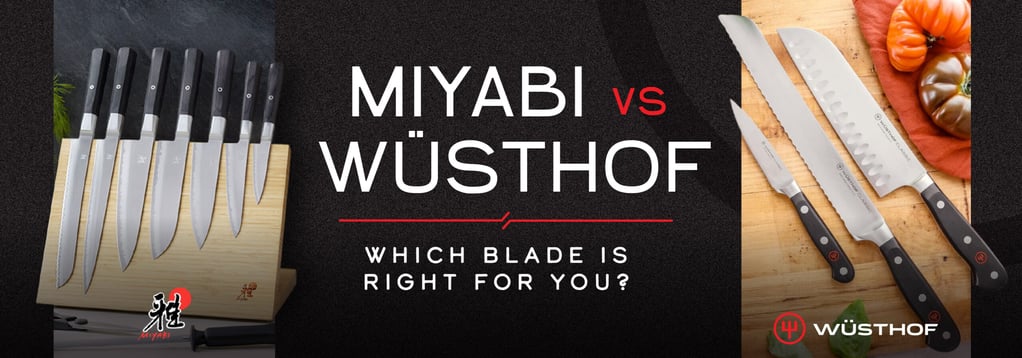
Miyabi vs. Wüsthof Knives: Craftsmanship, Blade Material, and Best Uses
Miyabi and Wüsthof both produce premium kitchen knives, though they emphasize different knife-making traditions. Miyabi leans into Japanese-style artistry, harder specialty steels, and fine-edge precision, while Wüsthof centers on forged German construction, balanced full-tang handling, and broad everyday versatility.
Miyabi vs. Wüsthof: Comparison Snapshot
| Category | Miyabi | Wüsthof |
|---|---|---|
| Overview | Japanese-style premium knives focused on refined craftsmanship, hard specialty steels, and precise cutting performance | German-style knives focused on forged construction, balanced handling, and everyday versatility |
| Typical Price Range | $$$-$$$$ | $$-$$$ |
| Strengths | Fine-edge precision, premium steels | Durable everyday performance, wider price range |
| Considerations | Higher costs | Heavier feel may not suit precision-oriented users |
| Best For | Fine slicing, detailed knife work | Daily prep |
Miyabi and Wüsthof are both recognized for high-quality construction, professional-grade performance, and knife collections designed to serve a range of cutting styles and preferences.
About Miyabi
Miyabi is a Japanese brand created in 2001 with the purpose of bringing Japanese craftsmanship to a broader market. Miyabi knives are a blend of Japanese techniques and German engineering, with a focus on meticulous finishing using the Honbazuke method. Each knife is made of premium steels through a process involving more than 100 production steps over a 42-day process.
Key Features:
- Artistry-forward construction
- Fine-edge blades
- Strong focus on slicing precision
About Wüsthof
Wüsthof is a long-established knife manufacturer based in Solingen, Germany, often called the "City of Blades". A family-run operation since 1814, Wüsthof produces 1.7 million knives yearly, each going through a 54-step manufacturing process that turns Wüsthof steel into a high-quality blade.
Key Features:
- Laser-sharpened edges
- Balanced, all-purpose handling
- Wide selection across multiple price points
Key Differences Explained
Miyabi and Wüsthof both produce premium kitchen knives, but they reflect different design traditions and cutting priorities. Looking more closely at craftsmanship, material, and cutting styles helps clarify which brand better fits your organization.
Craftsmanship
Miyabi’s craftsmanship is more elaborate and visually expressive, while Wüsthof focuses on function and balance. Miyabi knives are handcrafted using the Honbazuke method—a traditional Japanese knife sharpening technique involving a three-step process to achieve a razor-sharp edge. Wüsthof knives, on the other hand, use a laser-assisted sharpening process, and most blades are paired with full-tang construction and triple-riveted handles to ensure strength and durability.
Blade Material
Miyabi offers more variety in premium blade steels, while Wüsthof keeps a more unified German stainless approach. Miyabi blades use steels such as FC61 fine carbide stainless steel and SG2 micro-carbide powder steel, commonly hardened to 61 Rockwell. These steels are associated with fine edges, strong edge retention, and a distinctly crisp cutting feel. Wüsthof uses proprietary WÜSTHOF steel (a mixture of chrome, vanadium, molybdenum, and stainless steel) hardened to 58 Rockwell. That combination balances hardness, toughness, and stain resistance, rather than pushing toward the finest possible edge.
Precision and Cutting Style
Miyabi blades focus on precision cutting, such as push cuts, pull cuts, and fine slicing, where low resistance is important. Wüsthof’s knives are designed for consistency along the blade and function as all-purpose tools suited for mincing and chopping ingredients such as meat, fish, fruit, and vegetables. A sushi chef prioritizing precise cuts might want the slick elegance of a Miyabi, while a chef at a high-end steakhouse might need the versatile design of a Wüsthof.
Price Point
Wüsthof offers a broader entry range, while Miyabi is more concentrated in the premium segment. Wüsthof's chef knives typically fall between $200 and $300, while Miyabi can go beyond $500.
Which Knife Is Right for You?
Miyabi is the stronger match for fine-edge precision and elevated presentation, while Wüsthof suits users seeking broad, everyday versatility and a lower entry barrier.
| Scenario | Best Choice | Why |
|---|---|---|
| Precision Slicing | Miyabi | Harder specialty steels and Honbazuke-style finishing support clean, precise cuts |
| Daily Prep | Wüsthof | Versatile blade profiles suit a wide range of kitchen tasks |
| Budget Flexibility | Wüsthof | Broader spread of price points with lower entry options |
| Visual Craftsmanship | Miyabi | Damascus layering, hammered textures, and premium handle materials emphasize presentation |
Miyabi stands out for artisan-style craftsmanship, premium steels, and highly refined precision. Wüsthof stands out for balanced handling, and a lineup that spans from value-oriented to premium. In practical terms, Miyabi often fits detailed slicing and presentation work, while Wüsthof fits general prep and broader kitchen coverage.
Shop Miyabi & Wüsthof at KaTom
KaTom offers both Miyabi and Wüsthof knives, giving buyers a convenient place to compare premium cutlery from either brand in one catalog. Check out KaTom’s catalog to find the blade style and price point that best fits your kitchen.
