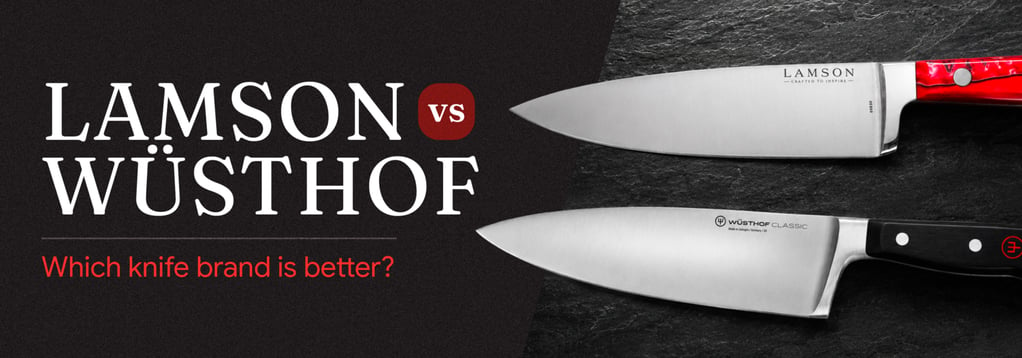
Lamson vs. Wüsthof
Lamson and Wüsthof offer similarly made professional knives known for their quality and performance. Lamson focuses on distinctive designs and handcrafted details, while Wüsthof emphasizes precision manufacturing and a range of knife styles. Both deliver reliable performance, with the main differences coming down to design and value.
Lamson vs. Wüsthof: Comparison Snapshot
About Lamson
Silas Lamson and his sons founded Lamson Knife Company in 1837 in Shelburne Falls, Mass. The company is known as the oldest continuously operating cutlery manufacturer in the United States. Lamson gifted a 62-piece dinner set to President Ulysses S. Grant in 1869, and the set is currently housed in the Smithsonian's National Museum of American History. Today, Lamson is headquartered in Westfield, Mass., where it continues to produce forged and stamped kitchen tools and cutlery.
Key Features:
- Ice-hardening on some blades strengthens the steel
- Full-tang construction with double- or triple-riveted handles gives the knives weight and stability
- Knives come with a lifetime warranty against manufacturing defects and the Sharp for Life program, which enables customers to mail knives in for professional sharpening
About Wüsthof
Established in 1814 by Johan Abraham Wüsthof in Solingen, Germany, Wüsthof has remained under family ownership for seven generations. What began as a small shears workshop evolved into a global cutlery manufacturer known for forged knives that are still produced in Solingen, nicknamed the City of Blades. Today, Wüsthof blends centuries of craftsmanship with modern production techniques.
Key Features:
- PEtec laser-sharpens blades, helping them stay sharper longer
- A thick bolster protects fingers and gives knives a professional feel
- Blades are forged or stamped from a single piece of German stainless steel
Key Differences Explained
Knife Construction
Understanding X50CrMoV15 Steel Composition
| Component | Meaning | Benefit |
|---|---|---|
| X | Stainless steel designation | Corrosion resistance |
| 50 | 0.5% carbon | Edge sharpness and strength |
| Cr15 | 15% chromium | Rust and stain resistance |
| Mo | Molybdenum | Improves hardness and corrosion resistance |
| V | Vanadium | Improves wear resistance and edge retention |
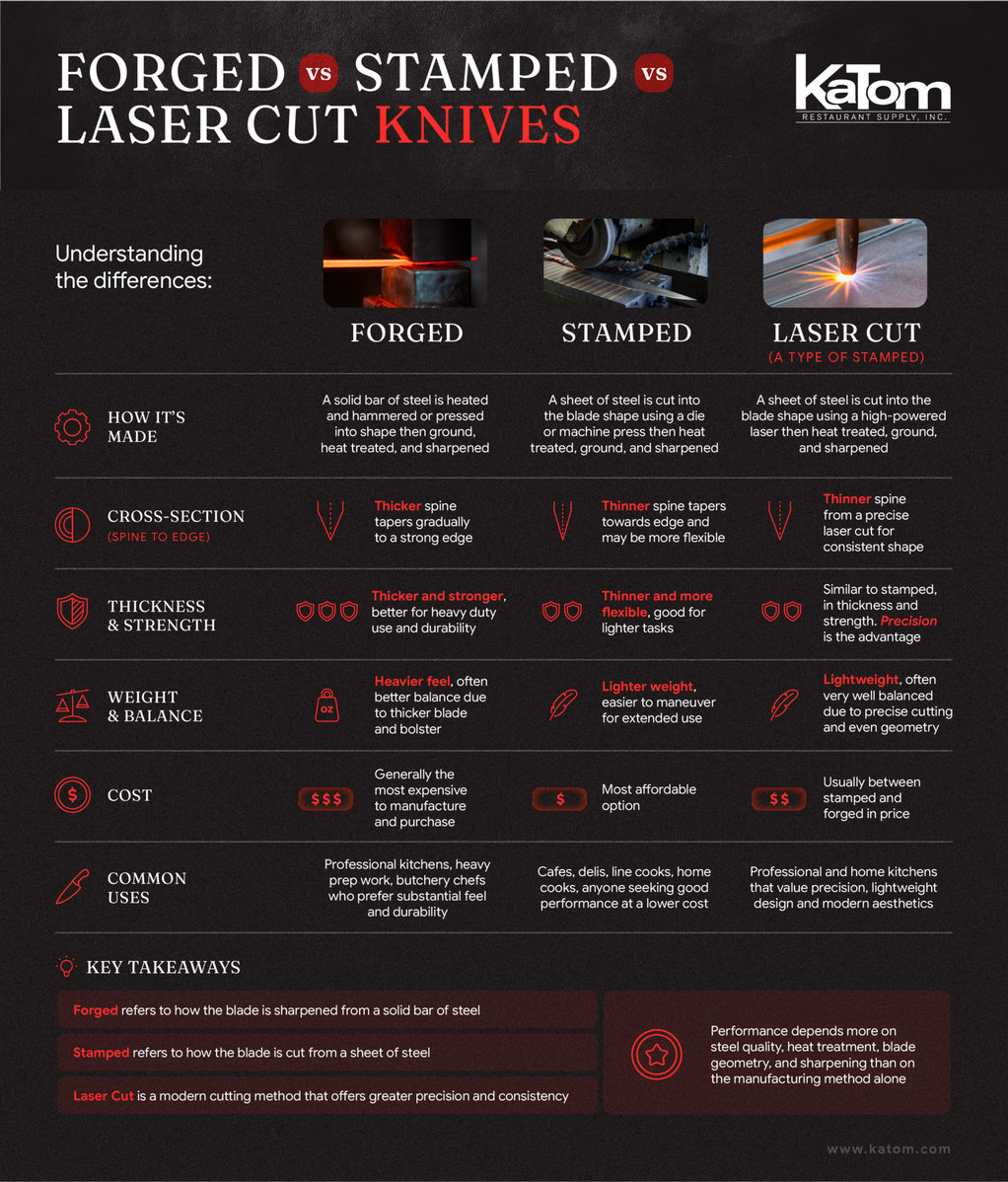
Lamson produces laser-cut, stamped-style knives from high-carbon stainless steel. All Lamson knives use full-tang construction. Lamson's Premier Forged line provides a full bolster that adds weight for balance, acts as a safety guard for fingers, and reinforces the strength of the knife.
Wüsthof knives are constructed of the same material as Lamson. The brand offers forged and stamped knives in various weights and qualities. Most Wüsthof knives utilize full-tang construction, giving the knife a balanced center of gravity. Depending on the collection, Wüsthof manufactures full bolster, half-bolster, and no-bolster knives.
Steel and Edge Performance
Lamson's main collections, the Premier Forged Series and Vintage series, use tempered stainless steel with a hardness of 58 HRC. Due to this rating, the knives retain their edge longer while remaining simple to maintain and sharpen. This combination of hardness and toughness provides reliable cutting performance while reducing the risk of edge chipping.
Wüsthof's comparable alloys are hardened to similar HRC levels, resulting in similar edge retention and durability. Wüsthof's additional PEtec technology uses a laser-guided sharpening process that produces a consistently sharp edge and supports long-term cutting performance.
Maintenance and Durability
Maintenance is similar because both brands use of German stainless steel and comparable HRC levels. Their blades resist corrosion, respond well to honing, and can be sharpened using standard sharpening tools. Never place knives in the dishwasher, since high heat and harsh detergents can cause steel to pit and damage the handles. With proper care and maintenance, Lamson knives can last five years in commercial environments, while Wüsthof models can remain in service 15 years or more.
Product Selection
Lamson offers two primary knife collections. The Premier Forged and Vintage series showcase a variety of knife styles as well as block sets. Specialty knives include the Brad Leone Signature Series, vegetable and prep, santoku, cheese, and tomato knives. Owners can customize handle materials and wood blocks across select lines.
Wüsthof is known for its chef's knives, which come in numerous collections, including Classic, Classic Ikon, Performer, Amici, Urban Farmer, Gourmet, and Partner. Specialty knives include santoku, bread, paring, utility, oyster, cheese, and salmon-slicing knives. Block configurations are available from starter sets to custom block sets. Wüsthof also offers handle customization in its Classic Color series.
Which Knife Brand Is Right for You?
| Scenario | Best Choice | Why |
|---|---|---|
| High-Volume Operations | Wüsthof | Provides forged knives manufactured to withstand demanding prep work |
| Operators Seeking Unique Designs | Lamson | Offers distinctive handle materials and finishes that stand out from more traditional knife designs |
| Broad Product Selection | Wüsthof | Offers an extensive line of chef's knives, specialty blades, and knife sets for a variety of applications |
| Value-Focused Operators | Lamson | Provides forged cutlery with premium materials and craftsmanship at competitive prices |
Shop Wüsthof at KaTom
KaTom carries a wide range of Wüsthof knives suited for both professional chefs and home cooks. Compare Wüsthof knives by price, design, and performance to choose the best option for your needs.
