How to Design a Hospital Kitchen
A hospital kitchen should be designed around a workflow that moves food safely from receiving through storage, preparation, cooking, and service to prevent cross-contamination. It must fulfill clinical-grade sanitation, strict regulatory compliance, and dietary requirements that accommodate patient nutrition plans and medical restrictions. Efficient layouts, durable materials, and clearly separated zones ensure safe operations, consistent quality, and compliance with health and safety standards.
Key Takeaways
- The kitchen functions as a medical support hub; design must accommodate food as medicine, including renal, cardiac, and texture-modified diets
- A strict dirty-to-clean separation is mandatory to meet Joint Commission and local health department standards
- Unlike restaurants, finished food meets a high-speed assembly belt or pod system, not a traditional pass-thru
- Materials must withstand 24/7/365 operation and industrial-grade chemical sanitization
Why Hospital Kitchen Design Matters
Hospital kitchens must comply with the U.S. Food and Drug Administration's Food Code and additional state or local mandates, including:
- Hazard Analysis and Critical Control Points (HACCP) procedures
- Proper refrigeration, storage, and heating temperatures
- Routine oven, refrigerator, and thermometer calibration
- Documented cleaning schedules and sanitation logs

Efficient Hospital Kitchen Layouts
- Assembly Line Layout: Best suited for high-volume tray assembly and standardized menus
- Zone or Island Layout: Organized by function such as prep, cook, and wash for varied menus and flexibility
- Hybrid Layout with Mobile Equipment: Uses mobile appliances or modular workstations for rotating menus or evolving needs
Key Considerations for Hospital Kitchen Layouts
Hospital kitchens have unique design considerations because of the need for efficient workflow, strict food safety and healthcare regulations, and high-volume production.
Clinical Workflow Zoning
Layouts must separate raw, cooked, and soiled materials to prevent cross-contamination in sterile environments.
Specialized Dietary Logistics
Dedicated prep areas must safely manage complex medical diets, allergens, and texture-modified nutrition.
High-Volume Tray Assembly
The floor plan must accommodate rapid, sequential plating and heavy traffic from motorized meal delivery carts.
Regulatory Compliance
Designs must include access to emergency power and water systems to ensure uninterrupted patient feeding during outages.
Space Planning Requirements for Hospital Kitchens
Hospital kitchen layouts are dictated by the dirty-to-clean protocol. Planners must ensure that soiled patient trays never cross paths with freshly prepared meals. Inspectors focus on aisle widths for heavy carts, placement of specialized diet stations, and separation of high-risk prep areas.
Dedicated De-Boxing Room
In a clinical environment, the loading dock is a primary contamination point. The layout must include a dedicated de-boxing room or staging area outside the main kitchen entrance.
- Design Tip: Allocate 15 to 20 percent of the storage footprint for a transition zone equipped with industrial waste compactors and stainless steel dunnage racks
- Zone Separation Regulations: This zone must be physically walled off from active food production to prevent airborne contaminants from entering the clean kitchen core
Preventing Cross-Contamination in Healthcare Kitchens
The hospital kitchen layout should utilize a cellular design to prevent cross-contamination.
- Design Tip: Place the texture-modified station near the final assembly line to minimize travel time for high-risk, temperature-sensitive items
- Zone Separation Regulations: High-allergen prep zones require dedicated stainless steel tables and separate smallware storage to meet strict FDA and healthcare safety standards
High-Volume Tray Assembly Line
For facilities with over 200 beds, a parallel pod system is preferred over a single line. This layout enables multiple teams to simultaneously assemble dietary trays for different wards.
- Design Tip: Ensure a minimum 6-ft. clearance behind the assembly line for constant rotation of heated and refrigerated meal delivery carts
- Zone Separation Regulations: The assembly line must be positioned under a dedicated HVAC zone that maintains positive air pressure to keep surrounding prep areas from introducing contaminants
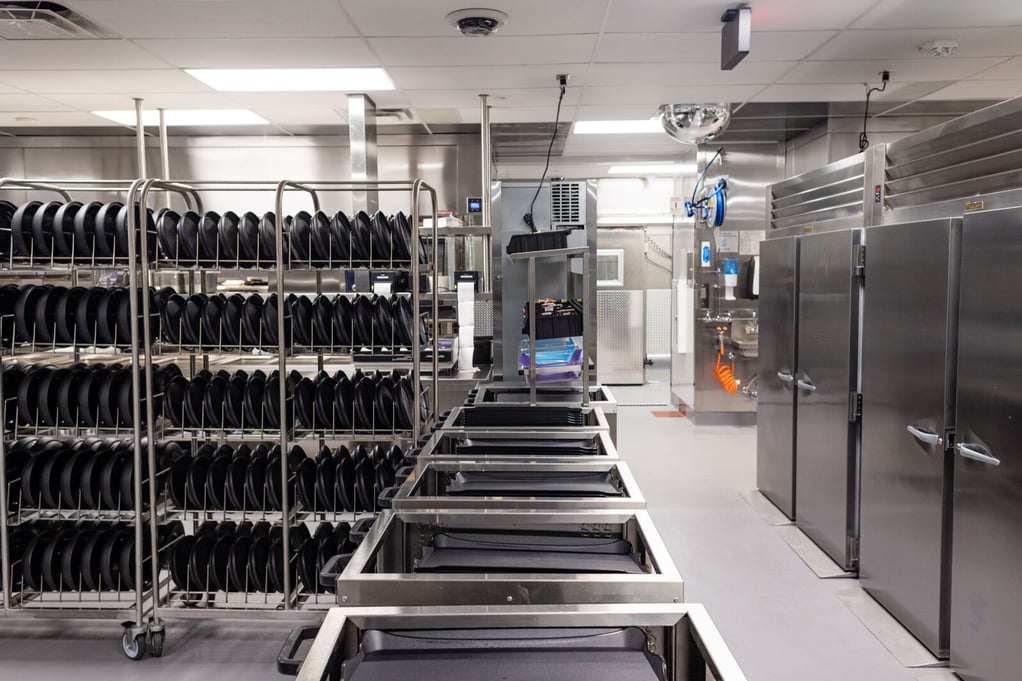
Warewashing and Cart Sanitation Loops
Hospitals must sanitize large meal carts after each use. Hospital kitchen layouts require wash-through loops to prevent contamination.
- Design Tip: Install floor troughs and high-volume drainage systems in the cart-wash area to manage heavy water runoff
- Zone Separation Regulations: A floor-to-ceiling partition must separate the soiled dish and scraping station from clean tray storage to prevent aerosolized bacteria from contaminating sanitized items
Point-of-Entry Wash Stations
The hospital kitchen layout must feature automatic, hands-free sinks at every transition point.
- Design Tip: Place sinks within 10 ft. of every workstation to encourage compliance and reduce staff travel time
- Zone Separation Regulations: Handwashing sinks must include 12-in. stainless steel splash guards when positioned within 18 in. of food preparation surfaces or clean utensil storage
Emergency 96-Hour Preparedness Storage
Healthcare facilities are often required to store a 96-hour supply of food and water for emergencies. This requires a separate dry storage vault to ensure emergency rations remain untouched and secure.
- Design Tip: Utilize high-density mobile shelving such as track-based systems to maximize vertical space without expanding the building's footprint
- Zone Separation Regulations: All emergency storage must be elevated at least 6 in. off the floor on non-porous, NSF-certified shelving to enable rapid floor sanitization and pest inspection
What Equipment Is Needed in a Hospital Kitchen?
Hospitals require specialized equipment to support high-volume production, strict sanitation standards, and dietary needs.
| Equipment Type | Key Equipment | Purpose | KaTom Pick |
|---|---|---|---|
| Food Prep | Immersion blenders, stainless steel prep tables | Supports pureed diets and safe prep workflows | Robot Coupe Immersion Blender |
| Cooking | Combi ovens, tilting skillets | Enables bulk cooking methods | Rational Combi Oven |
| Refrigeration | Walk-in coolers, pass-thru refrigerators | Maintains safe storage temperatures and efficient workflow | Traulsen Pass-Thru Refrigerator |
| Warewashing | Flight-type dishwashers, waste pulpers | Handles high-volume sanitation and waste processing | Hobart Flight-Type Dishwasher |
| Dry Storage | Wire shelving, ingredient bins | Ensures airflow, organization, and FIFO compliance | Metro Wire Shelving |
