Commercial Ice Machine Cleaning and Maintenance
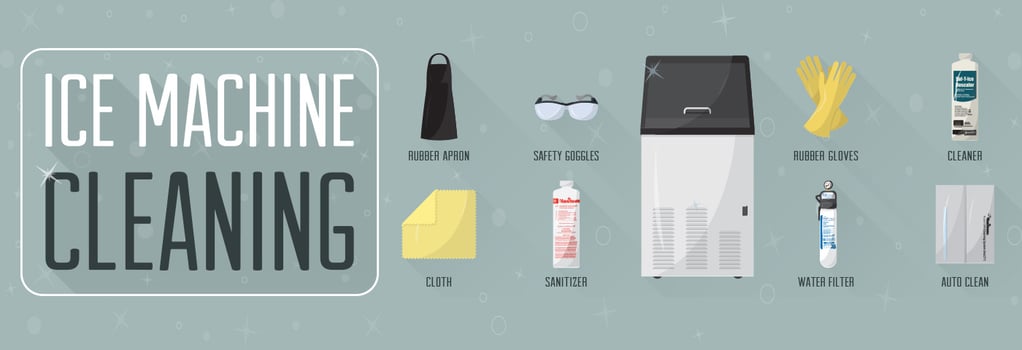
Has your commercial ice maker been acting up? A poorly maintained commercial ice maker often shows clear warning signs, including unusual odors or tastes, smaller-than-normal ice, reduced output, and lower efficiency. Over time, buildup inside the machine can also lead to higher energy use and potential health risks.
While mechanical failures occur, ITV VP of Sales David Hyttel notes that "the biggest problem is maintenance," and warns that "if you're not maintaining it, you will continue to have more and more service problems down the road."
Key Takeaways
- Poor ice machine maintenance can cause odor, off-taste, reduced ice production, lower efficiency, and potential health risks.
- Water quality is critical, as hard water leads to limescale buildup that can damage equipment and reduce performance.
- Installing and maintaining a proper water filtration system improves ice clarity, efficiency, and overall machine lifespan.
- Ice machines should be cleaned and sanitized regularly (at least every six months), with more frequent cleaning needed in poor water conditions.
- Both internal components and air filters require routine cleaning to prevent buildup from dust, grease, and organic contaminants.
Install an Ice Machine Filter
Hard water contains dissolved minerals that can enter ice machines and create cloudy, soft ice instead of clear, solid cubes. Over time, these minerals form limescale, a chalky buildup that reduces efficiency, forces the machine to work harder, and can eventually cause costly damage or equipment failure. Hyttel notes, "maintenance is really the biggest problem and right with it is water quality."
Installing a water filter is the first step in reducing these issues. Filters remove impurities and help improve ice clarity, machine efficiency, and production capacity by allowing ice to form more easily with cleaner water. Hyttel adds, "to keep your ice maker running smooth, you need to stay on top of changing filters and cleaning the machine."
Cleaning & Sanitizing Your Machine
Organic substances such as mold, mildew, fungus, algae and bacteria cause problems in your commercial ice machine. These like to collect in the dark, moist environment inside. Aside from being an eyesore, these organisms can get into ice, affect the taste, and some can potentially cause sickness. Your ice machine should be cleaned and sanitized regularly to avoid these problems. Cleaning and sanitizing are actually two separate but related functions. Cleaner will remove the buildup of limescale and other deposits from impure water, while sanitizer eliminates organisms like algae, slime, and bacteria.
Hyttel emphasizes that the industry standard is, "six months to do a full professional cleaning and maintenance of the machine," but you should perform a visual inspection every few weeks to make sure everything looks OK. Varied water conditions and environmental factors can necessitate cleaning more frequently. If you find yourself having to clean your machine more frequently than every 6 months, you should consult a service professional. You may have worse-than-normal water quality issues that should be addressed.
Cleaning and sanitizing procedures vary by manufacturer, and no two are identical. Review your use and care manual or the manufacturer’s website for step-by-step directions for the process. Some manufacturers print the instructions on the inside covers of their machines.
The process is typically the same for both procedures. The majority of ice makers have a ‘Clean’ button that puts the machine into a state where water continues to circulate, but the evaporator plate does not freeze to create ice. The operator typically adds cleaner or descaler first and lets that solution circulate for several minutes. Then, the system is purged of the cleaning solution and the procedure is repeated with sanitizer.
At some point in the process, the operator will remove parts like the water distribution tube, evaporator cover, and certain tubes for a manual deep cleaning that sometimes involves soaking those components in a cleaning solution to remove stubborn, built-up deposits.
Allow yourself plenty of time to perform the procedure, ideally a couple of hours after your restaurant is closed for the night so the machine will have time to replenish its supply of ice by the morning. The first couple of batches of ice produced after a cleaning and sanitizing are not safe to serve and must be discarded, so make sure someone will be present to handle that step.
Auto-cleaning features are becoming more common on commercial ice machines to eliminate much of the day-to-day labor of keeping your machine clean. Most require the operator to simply top off the cleaning solution reservoir, and select ‘Clean’ on the unit’s control panel. Sometimes these cleaning systems come as an accessory that must be installed separately, while others are built in.
Precautionary Measures
Use caution when handling ice machine cleaning and sanitizing solutions. They often contain strong chemicals like citric and phosphoric acid to break down lime scale and destroy pathogens, so they are also harmful to the skin and eyes. Wear rubber gloves and safety goggles. A rubber apron can also come in handy to protect your clothes.
Most cleaners come in a heavily-concentrated form and must be diluted with water before use in the machine. Failure to do so can damage the components of the machine. Using the wrong chemical or failing to dilute it properly can also void the manufacturer’s warranty.
Cleaning the Rest of Your Ice Machine
It isn’t just the wet areas of the ice machine that need cleaning. Dust and grease from the air can get inside the machine and affect its performance as well. Ice machines all include air filters to trap dust and debris before they enter the machine. Check your air filter once a month for dust and grease. Some are reusable, so they can simply be rinsed clean, and replaced. Others must be disposed of and replaced periodically.
Dust that makes it through to the inside of the machine should be cleaned out periodically as well. Pay close attention to the condenser coils. Even if they look clean on the surface, there can be a lot of dust between the tiny metal fins. Use compressed air or a soft, fine-bristled nylon brush to clean in those tight spaces. Fins are thin and delicate, and they can be bent easily, so use caution when cleaning them. Brush in the direction of the fins to avoid damaging them.
The exterior of your machine should be cleaned with a soft cloth and a gentle cleaner whenever you feel it’s appropriate.
References
- Ice in six out of ten restaurants has more bacteria than water from toilets. Daily Mail. Accessed February 2015.

