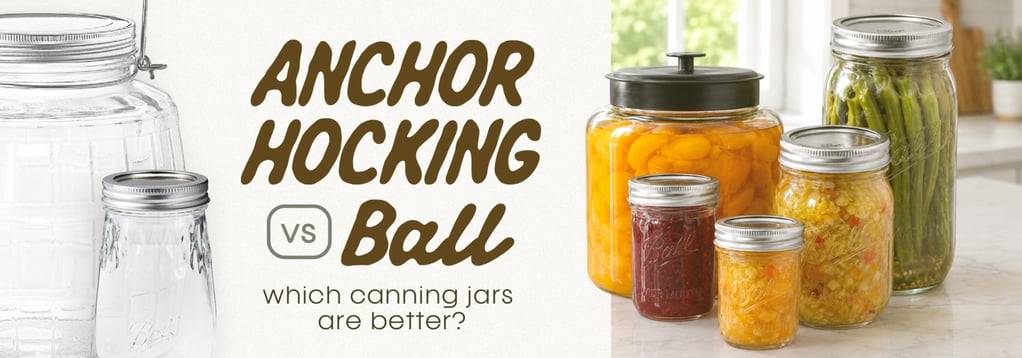
Anchor Hocking vs. Ball
Anchor Hocking and Ball are two of the most recognized brands in canning, offering durable glass jars for food preservation and storage. Both offer quality glass canning jars, but they differ in price, available sizes, and product selection.
Anchor Hocking vs. Ball: Comparison Snapshot
| Category | Anchor Hocking | Ball |
|---|---|---|
| Overview | Known for durable, affordable canning jars with smooth-sided designs and universal lid compatibility | Recognized for an extensive selection of canning jars, trusted sealing systems, and wide range of sizes and styles for preservation |
| Typical Price Range | $$ | $$$ |
| Strengths | Smooth sides simplify labeling and organizing; universal lid compatibility | Airtight preservation; durable glass construction |
| Considerations | Lid availability and compatibility; thinner lids; potential ring tightening issues | Not all jars are freezer safe; lids can't be reused; jars aren't suitable for ovens and microwaves |
| Best For | Budget-conscious canners looking for durable, straightforward jars with universal lid compatibility | Frequent canners who want the widest selection of jar sizes, styles, and canning accessories |
About Anchor Hocking
Isaac J. Collins founded Anchor Hocking in 1905 in Lancaster, Ohio, as the Hocking Glass Company. Anchor Cap and Closure Company later merged with Collins's company, becoming Anchor Hocking. Today, Centre Lane Partners owns Anchor Hocking and produces tempered glass products, such as bakeware, food storage containers, prep and measuring tools, drinkware, and specialty glass for worldwide distribution.
Key Strengths:
- Smooth, unbranded sides simplify labeling
- Thick, BPA-free soda-lime glass resists odors and stains
- Universal threading simplifies band and lid replacement
About Ball
Brothers Frank C. and Edmund B. Ball bought the Wooden Jacket Can Company in 1880. The remaining three brothers joined the family business. In 1886, the Ball Brothers opened a glass jar manufacturing factory, and a year later, they moved the business to Muncie, Ind. After years of manufacturing glass, Ball Corporation stopped producing glass jars in 1996 to focus on aluminum products. Today, Ball-branded canning jars are manufactured and distributed by Newell Brands.
Key Strengths:
- Jars withstand sudden temperature changes
- Two-piece sealing system vents air during processing while creating an airtight vacuum seal
- Specific straight-sided jars support frozen expansion, making them ideal for a variety of meal prep and preservation needs
Key Differences Explained
Performance and Reliability
Both Anchor Hocking and Ball offer durable glass canning jars designed to withstand the temperature changes associated with food preservation. Each brand provides regular- and wide-mouth options, making it easy to find compatible replacement lids and bands. Their sturdy glass construction and reliable threading help create secure seals for canning while supporting long-term food storage.
Anchor Hocking emphasizes simplicity and value with thick glass construction, smooth sides for easy labeling and organization, and universally sized threads that simplify replacing lids and bands. Ball distinguishes itself with strong thermal shock resistance and a two-piece lid-and-band system that vents pressure during processing. Ball jars are also suitable for cold and freezer storage, and the brand's widely available replacement lids and bands make it a convenient choice for frequent home canners.
Capacity and Product Selection
Anchor Hocking offers traditional canning jars in common sizes, such as 8 ounces, 16 ounces (1 pint), and 32 ounces (1 quart), with both regular- and wide-mouth options available. The brand focuses on straightforward, functional designs suited for everyday canning and food storage.
Ball also offers regular- and wide-mouth jars but provides a broader selection of sizes, specialty jars designed for jams and jellies, and decorative options for gifting, crafting, and pantry organization. This wider product selection makes Ball a versatile choice for canners with specialized preservation and storage needs.
Use
Check jars from both brands for chips or cracks that could prevent a seal or cause damage. Next, wash all jars, bands, and lids in warm, soapy water. Preheat jars to prevent thermal shock and cracking. Fill jars with food using a funnel to keep the rims clean. Slide a non-metallic utensil inside the jar to remove trapped air pockets, then place the lid on the rim and screw on the band. Remove jars from the canner, then cool them on a towel for 12 to 24 hours. A popping sound may indicate the jars have sealed properly. After cooling, the lid should be concave. If the lid isn't concave, the lid hasn't formed a vacuum seal, and it isn't safe for storage.
Price and Value
Pricing depends on the size and style of the jar, and both brands are widely available online and in stores. Anchor Hocking and Ball jars can be used for decades, and the bands can be reused; however, the lids can only be used once. Check jars for chips or cracks before reusing them.
Which Canning Jar Brand Is Right for You?
| Scenario | Best Choice | Why |
|---|---|---|
| Budget-Conscious Canners | Anchor Hocking | Typically offers a lower upfront cost while providing durable glass construction |
| Frequent Canning | Ball | Provides a trusted sealing system and a wide range of canning accessories and replacement lids |
| Specialty Preserving Projects | Ball | Offers more jar sizes, styles, and specialty options for jams and jellies |
| Simple Food Storage | Anchor Hocking | Smooth-sided jars and universal threading simplify labeling, organizing, and replacing lids |
Shop Anchor Hocking & Ball at KaTom
Whether you prioritize affordability or product variety, both Anchor Hocking and Ball offer reliable canning jars for preservation. KaTom carries a wide range of foodservice and kitchen supplies to support canning, storage, and food preparation needs.
