Culinary Knife Grinds
To stock your restaurant with the kitchen knives best suited to your needs, you need to know what materials comprise the blade and handle, the shape and intended purpose of the blade, and the type of grind used to give the blade its sharp edge. While the first two items on that list are relatively common knowledge, types of knife grinds often are a little more confusing. As with blade shapes, different knife grinds are best used for different tasks; the grind you choose determines the maintenance your knife will require.1 Learn about these different types of blade grinds here.
What Is a Knife Grind?
In order to explain knife grind options, first we must define the parts of a blade.
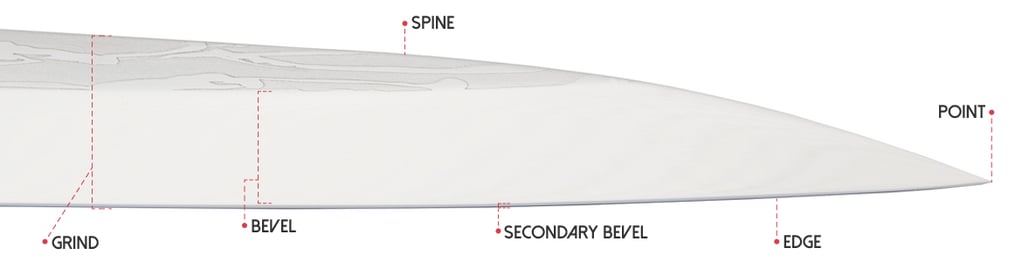
- The spine of the blade is the thick, dull top edge of the blade opposite the sharp cutting edge. The width of the spine may vary depending on the type of grind and how often the blade has been sharpened over its life on grinds that go all the way to the spine.2
- A blade's point is exactly what it sounds like: the end of the blade where the metal comes to a sharp angle. Depending on the shape and grind of the blade, the point may serve different purposes, but sometimes it's fragile and should always be treated with care.
- The edge is the thinnest part of the blade – the sharp surface of the kitchen knife that slices or chops through food.
- A bevel is where the flat side of the blade transitions into an angle to provide a sharp edge. Some blades also have a secondary bevel where the angle of the first bevel transitions into a more acute angle for a sharper edge. Not every blade has a bevel, as some are sharpened gradually across the entire side of the blade from the spine to create a flat or convex surface that ends in a sharp edge.
- The grind of the blade refers to the shape of the metal between the spine and the edge, or the angles or shapes used by the manufacturer or sharpener to provide a sharp edge. The shape of a grind is depicted most commonly with a cross section of the blade.
Types of Knife Grinds
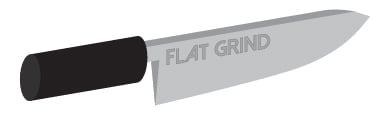
Flat-grind knife blades are V shaped on the cross section, with one straight line from the edge up to the spine on each side of the blade. This knife grind also sometimes is called a full-flat grind or a V grind. A true flat grind is somewhat rare on modern knives due to most manufacturers including a secondary bevel.
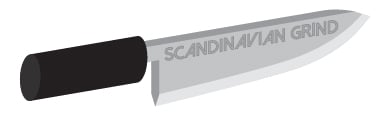
Both the Scandinavian grind and the saber grind are subcategories of a flat grind. These grinds may be called V grinds, so if you see that label on a blade, you may need to ask for further clarification. These types of blades also have a V shape, but rather than the angle going all the way up to the spine, instead there's a bevel partway down the blade, so a good portion of the blade is as thick as the spine. The only difference between a Scandi grind and a saber grind is how far the grind begins from the blade's edge. A saber grind usually is beveled halfway or more up the blade, while a Scandinavian grind is beveled less than halfway up the blade's sides.
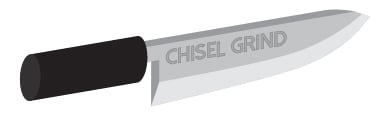
A knife with a chisel grind is ground only on one side; the back of the blade remains completely flat or is formed into a concave shape to limit food adhesion. The other side can be ground in one line to the spine, or from a bevel partway down the blade. This type of knife grind often is seen on Japanese culinary knives due to a traditional belief that this shape produces cleaner cuts, despite requiring more skill to use.3 Because of the one-sided grind, these knives are designed either for left- or right-handed use, which limits their versatility. They provide an incredibly sharp edge but require specialized sharpening and honing to maintain.
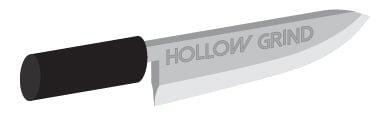
Hollow-ground knives are some of the sharpest knives available. This grind uses a bevel that curves inward until the two sides meet in a razor-sharp edge. This grind type requires frequent maintenance and is the most brittle of all grind types, so it isn't suitable for chopping, but its thin, sharp edge is ideal for slicing boneless meat, fruit, and vegetables. Many cook's and chef's knives feature hollow-ground blades.
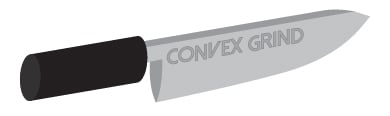
Knives with a convex grind use a convex curve instead of a beveled angle, curving to meet in a point at the edge. This knife grind isn't very common and can be difficult to sharpen but provides a very durable edge;4 many chefs prefer it for meat cleavers and butchers' knives.
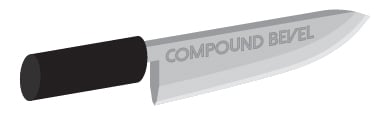
Double-bevel grinds, also known as compound bevels, are similar to Scandinavian or saber grinds, with a bevel starting partway down the blade. However, near the edge is a secondary bevel with a much more acute angle. This grind type is very durable but not as sharp as some of the other grinds. Common on Western-style and German knives, these blades usually have an angle of 20 to 22 degrees on the secondary bevel. This grind type can be combined with some of the styles above; for example, the knife used in the labeled image at the top of the page has a chisel grind as well as a compound bevel.
- Knife Edge Grinds and Uses. Lansky. Accessed August 2021.
- Knife grinds: flat grinds, hollow grinds, convex grinds and scandi's. Knives and Tools. Accessed August 2021.
- Understanding Single and Double Bevel Knives. Knifegeeky. Accessed August 2021.
- Blade Grinds. A. G. Russell. Accessed August 2021.
