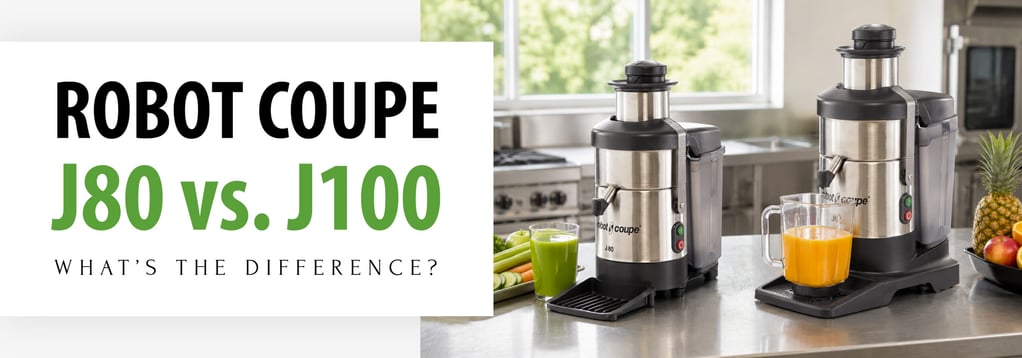
Robot Coupe: J80 vs. J100
Robot Coupe is well known for powerful motors, heavy-duty durability, and prep attachments for commercial use. While the J80 and J100 share many core designs, they differ in power, capacity, and output.
Robot Coupe J80 vs. J100: Comparison Snapshot
About Robot Coupe
Pierre Verdun and Robert Comte founded Robot Coupe in Burgundy, France, in 1961, where they designed their first commercial food processor. Today, Robot Coupe is recognized worldwide for fast food processors, prep equipment, juicers, and immersion blenders, with products available in more than 130 countries.
Key Features:
- Automatic feed system accepts whole fruits and vegetables
- Heavy-duty induction motors run at 3,450 RPM
- Speed and design help prevent juice from heating to preserve nutrients
Key Differences Explained
Juicing Performance and Capacity
Both the J80 and J100 models have motors that operate at 3,450 RPM without heating ingredients and compromising nutrients. The models feature automatic pulp ejection systems that separate juice from pulp during operation. They differ, however, in output.
The J80 has a 1-HP motor that produces 120 liters of juice per hour, making it suitable for low- to medium-volume operations, while the J100 is constructed with a 1 1/3-HP motor that yields 160 liters per hour.
Design and Ease of Use
The J80 and J100 feature an automatic feed hopper with a 3-inch feed chute that relies on gravity to simplify loading and eliminate the need for a pusher. Each juicer is built with a durable stainless steel base and bowl, an inclined base that promotes optimal juice flow, a drip tray to help keep work areas clean, and an automatic pulp ejection system that separates juice from waste during operation. Both models operate quietly, making them suitable for front-of-house environments, such as cafes, restaurants, and hospitality operations.
While the juicers have similar core designs, the J100 is built for higher-volume production. It features a larger 7-liter pulp container and a continuous waste ejection hopper that can discharge pulp directly into an external waste bin for uninterrupted operation, whereas the J80 includes a 6 1/2-liter pulp container. The J100 is also 3 3/4 inches taller than the J80, measuring 23 1/2 inches.
Maintenance and Durability
The juicers are manufactured with tool-free removable parts, simplifying disassembly and cleaning. The bowl, lid, and pulp containers are dishwasher safe, but hand washing with mild dish soap is recommended to prevent discoloration and prolong the service life of plastic components. Both models can be quickly rinsed between different batches of fruit by pouring water down the feed chute and running the machine.
Price and Value
While the J100 has a higher upfront cost, it offers a higher juice yield than the J80, making it better suited for high-volume operations. Both models combine power, durability, and features, resulting in a quick ROI and a lifespan of up to 12 years in commercial environments.
Which Juicer Is Right for You?
| Scenario | Best Choice | Why |
|---|---|---|
| High-Volume Operations | J100 | Its automatic feed system and higher hourly output help staff juice continuously during busy service |
| Small or Startup Businesses | J80 | Delivers commercial-grade juicing performance at a lower purchase price, making it ideal for operations with moderate juice demands |
| Ease of Cleaning and Maintenance | Either | Both models feature removable components, stainless steel exteriors, and tool-free disassembly for quick cleaning and routine maintenance |
| Hands-Free Operation | J100 | The automatic feed system lets operators continuously load produce without using pusher, reducing labor during service |
Shop Robot Coupe at KaTom
No matter the size or scope of your operation, KaTom offers Robot Coupe foodservice equipment to help prepare your kitchen for success.
