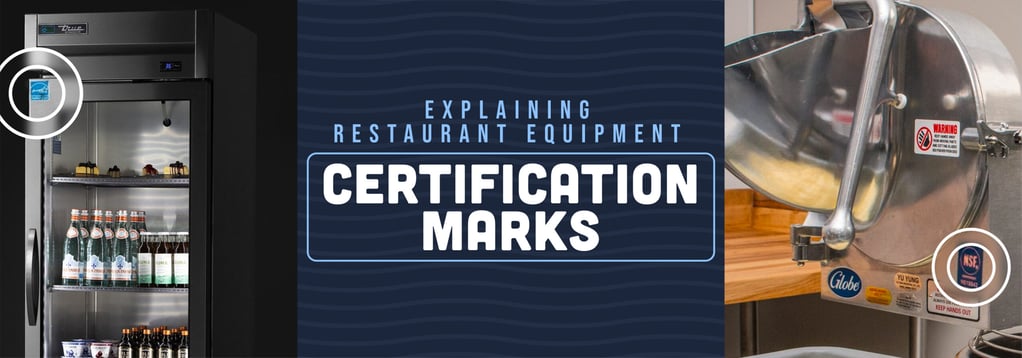
Restaurant Equipment Certification Marks
During the complicated process of deciding what equipment to purchase for your foodservice operation, one factor to consider is the safety certifications of the products you're looking at. Restaurant equipment certification marks are typically awarded by a trusted third-party organization to signify when a product meets certain recognized health, safety, or environmental standards.
There are several organizations whose certification marks you'll commonly see on commercial kitchen equipment. Learning about what company each symbol represents and the standards they test for can help you understand what to expect from the products you buy – and sometimes they might even sway your decision when you learn of the added benefits.
NSF Certification

Previously known as the National Sanitation Foundation at its conception in 1944 – and later as NSF International until the latter part was dropped in 2022 – NSF is a globally influential certification organization.1 The company's mission statement declares a dedication to "improving human and planet health." True to its values, NSF requires yearly inspections of any product or service bearing its mark to ensure health department regulations and safety standards are consistently being met. NSF employs a team of microbiologists, toxicologists, chemists, engineers, and environmental and public health professionals to accurately assess a product's safety.
An NSF certification is recognized at state, federal, and international levels, holding accreditations from the Occupational Safety and Health Administration (OSHA), the American National Standards Institute (ANSI), the International Accreditation Service (IAS), and the Standards Council of Canada (SCC). The organization even offers educational programs to help operators and manufacturers learn how to better adhere to its standards.
UL Certification

When it was founded in 1894, UL2 focused primarily on fire safety. Today, it has expanded to cover inspections for gas and electrical safety, food contact sanitation, marketing claim verification, sustainability, and more. Recognized internationally, a UL certification helps you to be sure no matter where a product is manufactured, it will adhere to safety standards and perform as advertised by the manufacturer. UL also offers engineering services and development support to help you avoid recalls and continue producing equipment that complies with health and safety standards.
ETL Intertek Certification
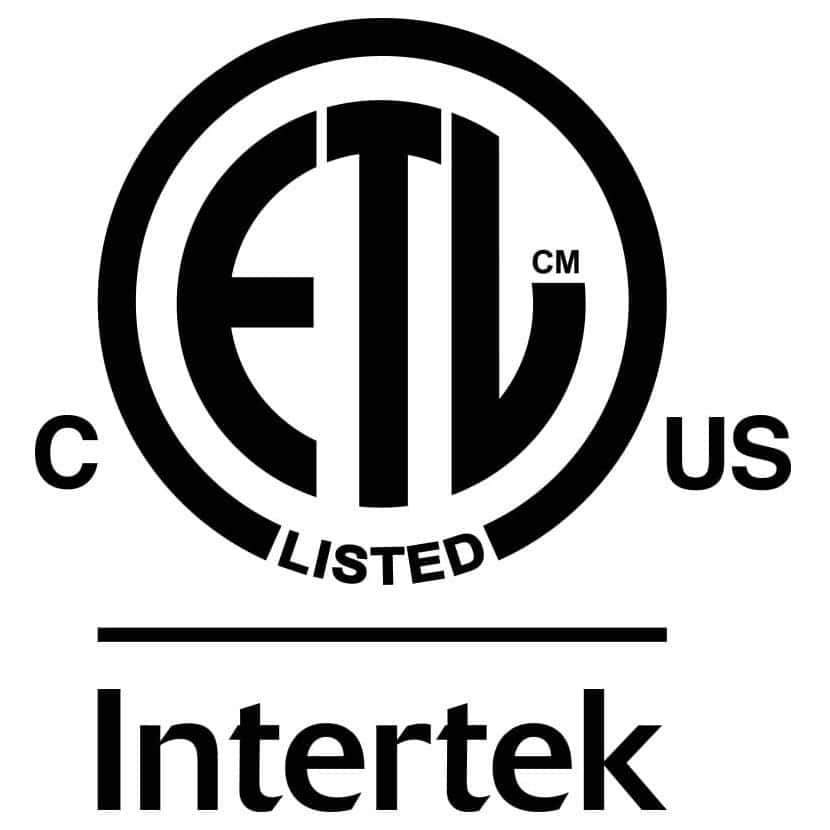
ETL was founded more than a century ago in Thomas Edison's lighting laboratories, and though it’s owned by Intertek today, it still signifies a product meets sanitation standards in addition to electrical and gas safety regulations.3 Certification by ETL is primarily recognized in the United States and Canada; however, additional certifications are available that are recognized internationally. Recognized by OSHA, ETL is classified as a Nationally Recognized Testing Laboratory and uses standards put forth by trusted organizations such as NSF, UL, ANSI, and more. This means an ETL certification covers multiple bases, and you might not need certifications from any of these other organizations.
CSA Group Certification

The Canadian Standards Association (CSA) was founded in 1919 to certify products manufactured or marketed in Canada have been tested for compliance with safety standards.4 Although the organization is based in Canada, its certification is recognized worldwide. CSA boasts ANSI and OSHA accreditations in addition to the United States Environmental Protection Agency (EPA) and Department of Energy (DOE). CSA emphasizes certifications for equipment powered by electricity or gas.
CE Certification

For products sold in the European Economic Area (EEA), a CE certification signifies the product meets the region's safety, health, and environmental requirements.5 A product bearing the CE certification mark is free to be traded within the EEA without restrictions. Any notified body – an organization accredited by the European Union – is qualified to award the CE mark. Certified products are often additionally sold outside the EEA in countries recognizing the CE mark. This means you may find the CE mark on many products sold in the US if they're also sold or marketed in the EU.
ENERGY STAR

An ENERGY STAR certification guarantees a product meets certain standards for environmental safety.6 In order to receive the certification mark from ENERGY STAR, a manufacturer is required to sign an agreement with the EPA, and the products being certified must be examined by a third-party organization confirming certain performance and safety requirements are met. The EPA oversees the certification of thousands of products and conducts regular audits to ensure continued compliance.
Products with an ENERGY STAR certification mark are typically more energy efficient, saving operators money on long-term costs. More efficient equipment achieves the same work using less energy, which leads to lower utility bills. ENERGY STAR also offers a rebate on many certified products after purchase.
AHRI Certification

The Air Conditioning, Heating, and Refrigeration Institute (AHRI) offers certification for any foreign and domestic Original Equipment Manufacturers and Private Brand Marketers – providing the company manufactures HVACR equipment.7 Companies looking to receive an AHRI Certification® must submit an application, after which AHRI will evaluate the equipment to verify its performance matches the claims stated by the manufacturer. An AHRI Certification is a promise that any spec sheets or product descriptions given by the company are accurate – meaning you should know exactly what to expect from the equipment.
References
- The NSF Mark. NSF. Accessed September 2023.
- Testing and Certification for Commercial Appliances. UL. Accessed September 2023.
- ETL Listed Mark. ETL. Accessed September 2023.
- About CSA Group. CSA. Accessed September 2023.
- CE marking. European Commission. Accessed September 2023.
- ENERGY STAR Certification. ENERGY STAR. Accessed September 2023.
- AHRI Certification. AHRI. Accessed September 2023.
